
The guitar is such a familiar and recognizable instrument today. But did you know that it has a history spanning thousands of years? Originating in ancient civilizations, it has evolved over time and and continues to develop today.
So where did the guitar really come from, and when did it become the instrument we recognize today?
Quick Navigation
What Came Before the Guitar? Early Stringed Instruments
The guitar is a chordophone instrument. Chordophone means that sound is produced by the vibrations of a string. The name is made up of the Greek word “chordae,” which means string and “phone” (tone/sound).
Although the guitar’s predecessors date back thousands of years, horns and percussion instruments are much older than stringed instruments. Like other musical instruments, the guitar developed because people have always wanted to express feelings that words alone cannot express.
Eastern Ancestors of The Guitar
The origins of the guitar can be traced back to the stringed instruments of ancient civilizations. The guitar’s earliest family tree is still debated. Among the earliest known ancestors of the guitar are the tanbur, a Middle Eastern lute dating back to 1500 BCE, and the sitar, an Indian instrument from around 700 CE. These instruments featured a hollow wooden body and a long neck with multiple strings, characteristics that would later influence the development of the guitar.
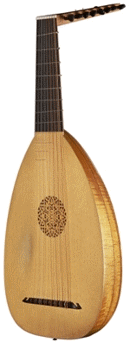
By the time Alexander the Great died in 323 BC, his empire stretched from Greece and Egypt deep into Asia, leading to an exchange of cultures between peoples. The guitar’s earliest family tree is still debated. Ancient instruments from the Middle East, Greece, Rome, and later medieval Europe shared features that would eventually appear in guitar-like instruments. It is possible that the Assyrian Zither was passed on to the Greeks and then to the Romans, who named the instrument Cithara romana.
A thousand years later, instrument makers in the south of France added a neck and fingerboard and called their instrument Chrotta. Around 100-200 AD, the lute appeared briefly in Rome and then disappeared for centuries after the fall of the Roman Empire.
The Instrument the Church Tried to Ban
The zither and arched rebab were played widely in Spain and Portugal during the Middle Ages and later throughout Europe. The rebab resembled a mandolin (pear-shaped) with a flat top, two sound holes, a bridge, and a short neck.
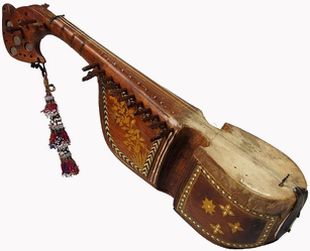
In the 12th century, a new Spanish instrument appeared: the Laud, a pear-shaped musical instrument that combined features of earlier guitar-like instruments and the lute. This instrument descended from the Arabic Lute known as the ‘Oud,’ which came to Spain during the Moorish invasion. The Laud later spread to the rest of Europe, where it was known as Lauthe in Germany and Lute in France.
The design of the first guitars borrowed the basics of both the Arabic oud and the French Chrotta. Numerous religious wars forced many Chrotta players to travel to Aragon and Catalonia, and new instruments mixing features of the Chrotta and Laud began to appear there. This event probably sparked the development of the guitar.
During this same period, Marco Polo returned to Italy from his travels in Asia. He brought back stories of unfamiliar cultures, trade goods, and musical instruments that were very different from those Europeans knew at the time.
In the 13th century, the Spanish church banned the rebab, considering it an instrument of the devil. However, among ordinary people, the rebab remained extremely popular among ordinary people, despite the church’s prohibition on the use of musical instruments. The rebab underwent only minor changes until the 16th century and later became known as the mandola, which was especially popular in Spain.
When Did the Guitar Finally Start Looking Like a Guitar?
Instrument makers experimented with sound, sound projection, and wood types and shapes. The flat-back design concept came back into fashion, resulting in an instrument that was the direct predecessor of the modern guitar.
Vihuela: Predecessor of the Modern Guitar
Its name comes from the Roman term Fidula. The Vihuela looked a lot like a modern guitar. Most had six pairs of strings and were tuned much like a lute.
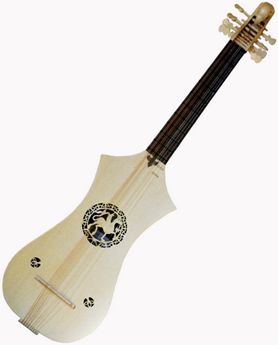
There were also variations with four or seven pairs of strings. The richly decorated Vihuela was very expensive, so ordinary players preferred the four-stringed Chitarra Latina, which was very similar to the vihuela, but simpler. The Chitarra Latina dates from the late 13th century and had eight sound holes arranged in two groups of four.
How One Extra String Changed the Guitar Forever
During the 16th century, guitars with five pairs of strings became increasingly common, especially in Spain. Today we know this new version as the Spanish guitar.
The Vihuela, along with the four-stringed Guitarra Morisca, and the Cuitarra Latina, paved the way for the classical guitar we recognize today.
Soon this five-string guitar appeared everywhere and gradually replaced the more complex Lute. Lute aficionados denounced the guitar and tried to ruin its reputation by associating the guitar with obscene bodily movements and moral destruction. In that sense, the reaction was not so different from what happened centuries later whenever the guitar underwent major changes.
The same happened in the 1950s and 1960s, when the increasingly popular electric guitar was criticized on moral grounds. But the more people criticized the guitar, the more popular it became. Romantic young men serenaded women who enjoyed hearing it. It wasn’t so different from today, when young fans go crazy for their favorite artists.
By the 17th century, French and Italian guitars had slimmer waists and were already close to the shape we recognize today. However, an important difference was the five pairs of strings instead of the six or twelve of the current guitar.
During the Renaissance and Baroque eras, the guitar experienced significant growth in popularity. The Baroque Guitar, a smaller instrument with five doubled strings, emerged as a favorite among musicians and composers. The Baroque Guitar was often used for accompanying singers and dancers, and it played a vital role in the development of guitar techniques and compositions.
Why Six Strings Won
Carulli’s 1810 guitar was one of the first to use six strings, tuned the same as today’s: E A D G B E. Guitar makers also began switching from paired strings to single strings. This also solved tuning problems caused by pairs of gut strings not being the same diameter.
Antonio Torres: The Man Who Gave the Guitar Its Modern Shape
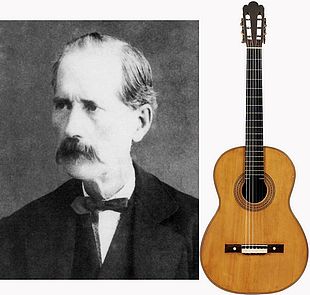
The late 18th and early 19th centuries saw the rise of the six-string guitar, which would become the standard design for the instrument. The classical guitar, as it is now known, was the result of innovations by Spanish luthiers such as Antonio Torres Jurado, who improved the instrument’s size, shape, and sound quality.
Torres made the guitar body larger, used a scale length of about 65 centimeters, and improved the fan bracing under the top. His guitars were louder and fuller, and his basic design became the model for the modern guitar. He was one of the first to use mechanical tuning mechanisms and widened the support bars so that the strings on the body were slightly wider apart.
The Nylon String Revolution: How the Guitar Earned Its Place on the Stage
The modern classical guitar has’t changed much since then. One of the last big changes came in the 1940s. For centuries, guitar strings were made from animal gut, mostly sheep intestine. In the 1940s, nylon began replacing traditional gut strings.
Nylon had been developed at DuPont in the 1930s by a team led by American chemist Wallace Hume Carothers.
These enhancements made the classical guitar the preferred choice for virtuosic performers and composers like Fernando Sor, Mauro Giuliani, and Francisco Tárrega.
The guitar became increasingly popular, and more and more music was written for it. Rossini, Haydn, Berlioz, and Schubert, among others, composed for guitar.
At the end of the 19th century, Francisco Tarrega revived Spanish music. Modern classical guitarists still have his compositions in their repertoire. He made various arrangements of Chopin, Beethoven, and Bach.
The guitar’s acceptance as a modern concert instrument was due to Andres Segovia, one of the greatest musicians in history. Segovia was largely self-taught and showed audiences around the world just how much one guitarist could do with a single instrument. He also arranged many works for guitar by Haydn, Handel, Mozart, and many others. For more than fifty years, he performed around the world and helped bring the guitar to new audiences.
During the 19th century, C.F. Martin helped develop X-bracing, which made acoustic guitars stronger and more powerful. Later, Orville Gibson took guitar design in another direction with his carved-top guitars. These enhancements further increased the guitar’s volume and tonal range, making it even more versatile and desirable.
How Steel Strings Changed the Sound of the Guitar
The turn of the 20th century witnessed the birth of the steel-string guitar, a major milestone in the instrument’s history. Developed in the United States, the steel-string guitar quickly gained popularity due to its louder and brighter sound, which was better suited to accompany larger ensembles and growing styles like blues, jazz, and country. The steel-string guitar’s popularity soared, and it soon became more popular than the classical guitar in the United States.
The Giant Guitar That Tried to Become a Bass
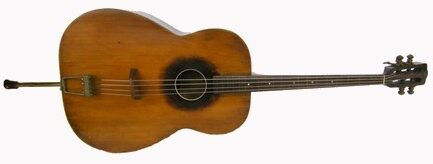
In the late 1930s, the Chicago-based Regal Musical Instrument Company introduced the Bassoguitar, which could be considered an early form of the bass guitar. The instrument was a cross between a flat-top acoustic guitar and a double bass and measured 1.80 meters long.
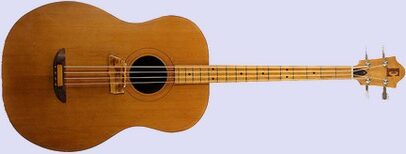
The first Earthwood acoustic bass guitar appeared in 1972. It was designed by Ernie Ball with former Fender associate George Fullerton. However, Earthwood was not a success and production ceased in 1974.
The Electric Guitar Revolution
In the 1930s, the electric guitar emerged, forever changing the landscape of popular music. Inventors like George Beauchamp and Adolph Rickenbacker pioneered the development of the electric guitar, which used magnetic pickups to amplify the vibrations of the strings, producing a much louder and more powerful sound.
Adolph Rickenbacker was born in Basel, Switzerland, in 1887 and moved to the United States with his family in 1891. In 1928 he moved to Los Angeles. Here he founded the Rickenbacker Manufacturing Company and manufactured metal bodies for the National Steel Guitars Company. There he met George Beauchamp and Paul Barth.
Together they founded a new company in 1931, the Ro-Pat-In Company. The following year they began developing the first aluminum versions of the Steel Guitar. In 1934, the company name was changed to Electro String Instrument Corporation. The Steel Guitar was especially popular in “Hawaiian” music, where it often dominates.
A Lap Steel Guitar is played flat across the player’s lap or on a stand. Instead of pressing the strings against frets, the player moves a steel bar across them. This creates the smooth sliding sound heard in Hawaiian and steel-guitar music.
The Frying Pan: The Strange Guitar That Started an Electric Revolution
Back in 1930, Beauchamp was experimenting with a well-known fact: if you move a copper wire along a magnetic field, it will change the strength of the magnetic field. He wrapped copper wire around a magnet to make a coil, then positioned a metal string above it. The movement (vibration) of this wire changed the electric current in the coil. This made it possible to amplify the sound of the guitar electrically.
Beauchamp found a way to turn the vibration of steel strings into an electrical signal using a magnetic pickup. After a lot of experimenting, he and his partners built a pickup around two horseshoe-shaped magnets. This made it possible to amplify the guitar clearly and reliably.
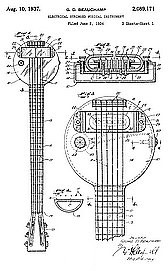
George Beauchamp contacted Harry Watson, then Chief Superintendent of National String Instrument Co. Watson was impressed by Beauchamp’s invention and built a model with a single-piece neck and body. Then he mounted the electric amplification element developed by Beauchamp and Barth at the bridge of the body. Beauchamp named this prototype ‘The Frying Pan.’
The Frying Pan became the first electric guitar to go into production and worked according to the principle still applied today. The Frying Pan was an immediate success among steel guitarists.
Who Really Invented the Electric Guitar?
But already in 1925, one Lester William Polsfuss (Les Paul) had created an invention that not only amplified the sound of the guitar but also gave it a very unique sound. For this reason, can we consider Les Paul the inventor of the electric guitar?
The truth is that the Electric Guitar was not invented by one single person. George Beauchamp and Adolph Rickenbacker helped put the first successful electric guitars on the market in the early 1930s. Les Paul later pushed the solid-body idea much further, building his famous Log in 1941.
The electric guitar’s invention opened the door for countless musical innovations and the rise of new genres such as rock ‘n’ roll, surf music, and hard rock. Guitarists like Charlie Christian, T-Bone Walker, and Les Paul contributed significantly to the evolution of the electric guitar, both in terms of playing styles and technological advancements.
Three Guitars That Changed Popular Music
In 1950, Leo Fender introduced the Fender Broadcaster (later Telecaster), the first mass-produced solid-body electric guitar. This groundbreaking instrument featured a simple design, with a single-cutaway body, two pickups, and a bolt-on neck, making it affordable and accessible to a wider range of musicians. The Telecaster quickly gained popularity among country and blues guitarists for its bright, twangy sound and distinctive look.
The 1950s and 1960s marked the golden age of electric guitars, with numerous iconic models being introduced by companies such as Fender, Gibson, and Rickenbacker. In 1952, Gibson released the Les Paul, a solid-body electric guitar designed in collaboration with the renowned guitarist Les Paul. The Les Paul featured a set-neck design, two P-90 single-coil pickups, and a carved maple top. In 1957, Gibson added humbuckers, helping create the thick, powerful sound the Les Paul later became famous for.
In 1954, Fender released the Stratocaster, a solid-body electric guitar with a contoured body, three single-coil pickups, and a revolutionary tremolo system. The Stratocaster’s versatile sound and ergonomic design made it an instant hit, and it quickly became the go-to instrument for guitarists like Jimi Hendrix, Eric Clapton, and Stevie Ray Vaughan.
The 1960s also saw the introduction of other iconic electric guitars, such as the Gibson SG, the Rickenbacker 360, and the Fender Jaguar. These instruments, along with countless others, shaped the sound of popular music during this era and cemented the electric guitar’s place in music history.
How the Guitar Conquered America
In the southern United States, music began to develop as African and European influences mixed between black and white people. It is almost certain that the instrument, made from a gourd covered with leather, is the predecessor of the modern banjo. In those days, slaves also made their guitars from large cigar boxes, brooms, and rope. But most of the guitars in Colonial America at that time were made in England.
In the southwestern United States, Mexicans played the guitar as well as the 16th-century vihuela. Spanish missionaries brought instruments to California, and cowboys also used the guitar to calm the herds on the night prairies.
Why the Guitar Was Perfect for the Blues
Blues music originated in the Mississippi Delta and developed from work songs, shouts, and other field calls. Harmonious gospel tunes were often accompanied by banjos and later primitive guitars, sometimes played with a metal rod or bottleneck. Running it across the strings created the whining and whining sound so typical of the blues, but now widely used in other musical styles.
Music has always contributed greatly to religion in both the rural South and the Midwest. All social activities at that time revolved around religion. The guitar was often played on farms, plantations, and mining camps. The instrument was easy to transport, it was relatively inexpensive, and almost anyone could learn to play three or four chords on it.
In big cities, poor people took their guitars out into the street. American blues, country, and folk music focused on the guitar for the same reasons: it was inexpensive, easy to transport, easy to play, and sounded good.
Why Jazz Forced the Guitar to Go Electric
In the jazz bands of New Orleans and Chicago, guitar playing was not so easy. No matter how hard the detuned guitarist hit, he never rose above the horn section and piano. But soon these self-ignoring guitarists were able to take revenge through the microphone, amplifying the instrument.
Electric amplification had a major impact on guitarists, but not everyone liked the new sound at first. Guitarists such as Eddie Long, Freddie Green, Charlie Christian, and Eddie Condon brought new sounds, ideas, and techniques to jazz. From his twenties into his early forties, Eddie Condon was one of the biggest names on the Chicago jazz scene. The electric guitar developed quickly during this period. Eddie Durham was one of the first jazz guitarists to seriously experiment with amplified guitar. His playing helped show what an electric guitar could do in a jazz band and opened the door for players like Charlie Christian.
Another important musician was the Romani jazz guitarist Django Reinhardt. He was born on January 23, 1910, in Liberchies, Belgium, and played guitar from the age of twelve. Then, on November 2, 1928, disaster struck. There was a fire in his caravan, and Django was able to escape at the last minute, suffering severe burns. The fire badly damaged the ring and little fingers on Django‘s left hand, and doctors doubted he would ever play normally again. But Django refused to give up. He rebuilt his technique and learned to play most of his solos mainly with his index and middle fingers, while still using the injured fingers for some chords.
Django was Europe’s answer to American jazz and influenced many American guitarists, especially after World War II, such as Les Paul, B.B. King, and Wes Montgomery. His group, Quintet Du Hot Club de France, which included violinist Stephane Grappelli and his brother Joseph, became a sensation. Django Reinhardt died in Fontainebleau in 1953 from a cerebral hemorrhage and left behind historical records.
In the decades that followed, guitarists such as Les Paul, Kenny Burrell, Jim Hall, George van Eps, Barney Kessel, Wes Montgomery, Tal Farlow, Herb Ellis, and Joe Pass continued to experiment with different time signatures and melodies.
How Country Music Fell in Love With the Guitar
In country music, almost every major artist used the guitar, including Hank Williams, Jimmie Rodgers, Hank Snow, Ernest Tubb, Merle Haggard, and, of course, instrumentalists such as Roy Clark, Merle Travis, Glen Campbell, and Jimmy Bryant.
Chet Atkins, known as “Mr. Guitar,” became one of the most versatile and respected guitarists of his time. He started with simple homemade instruments, stringing a ukulele with wire from a screen door, built various guitars himself, and developed new methods of playing and recording. Later in his career, the Tennessee musician also branched out into classical and popular music, but instrumental country remained his signature style. Chet Atkins‘ style combined smooth melodies and harmonies with a strong, steady bass line, all played at the same time.
How Elvis Made the Guitar a Rock n Roll Symbol
After World War II, mainstream audiences weren’t paying much attention to jazz or country guitarists. Then, in the mid-1950s, a new kind of music changed everything. Among all the pop singers and sugary ballads, someone completely different appeared: the King of Rock and Roll. With his swaying hips, long black hair, wide sideburns, tight clothes, and raw energy, he looked like no one else: a truck driver from Tupelo named Elvis Presley.
He was a completely new phenomenon, and a new generation of American teenagers found a hero their parents hated. He was perfect! Everyone soon realized that this man was no ordinary musician. One detail mattered enormously: he performed with a guitar. He strummed furiously, swung the guitar around, and even slung it behind his back. It was pure, explosive showmanship. And as Elvis became a superstar, the guitar went everywhere with him.
Elvis was kind, religious, and, above all, respected his parents. Even though he made his first record for his mother, he came under attack from conservative radio hosts who thought he was a bad influence on young people. But, a new generation supported Elvis and bought 10 million of his records in 1956. Many people started playing guitar thanks to Elvis.
Young people looked at Elvis and thought, “If he can do it, so can I.” When it came to guitar playing, they were right: songs like “Hound Dog,” “Surfin USA,” “This Land is Your Land,” “Mr. Tambourine Man,” and many other similar songs were easy to play. The same was true of many rock, blues, country, and folk songs by B.B. King, Bob Dylan, Joan Baez, The Rolling Stones, and many others.
Elvis himself was no more and no less than the average guitarist. The real guitar work was done by his regular guitarist and friend Scotty Moore, who came up with the distinctive riffs that helped define rock n roll.
Songwriters Jerry Leiber and Mike Stoller also played a major role in Elvis’ success and helped create many of his hits. His manager, Colonel Tom Parker, also played a major role in his success.
Andreas Cornelis van Kuijk, born in Breda, the Netherlands, in 1909, had a sharp sense of how to market Elvis Presley and his music.
After his military service, which Colonel Parker had carefully planned around his career, Elvis worked on making a comeback. Elvis made a huge comeback in 1968 with his famous NBC TV special. The show put him back in the spotlight and led to his return to live performances in 1969. But his success came at a heavy price. On August 16, 1977, Elvis died at his Graceland mansion in Memphis. After his death, Elvis became more popular than ever, and his music continued to sell to new generations of fans. The recordings continue to be reissued and continue to attract new listeners.
When Guitar Music Took Over the Radio
In the early days of rock and roll, instrumental songs were very popular. All you had to do was turn on the radio and you would hear a saxophone, guitar, or organ. Songs like Tequila by the Champs and Red River Rock by Johnny and the Hurricanes received good reviews. Walk Don’t Run, a Ventures classic, stayed on the charts for nearly five months and peaked at number two.
In England, The Shadows made their mark with songs such as Apache, Atlantis, Wonderful Land, and many others. Duane Eddy created his famous “twang” by playing strong melodies on the guitar’s low strings and using plenty of reverb. He later joked that he eventually discovered the guitar had higher strings too. Like other records of the time, Duane Eddy‘s record was not polished to modern production standards, but songs like Ramrod, Rebel Rouser, and Cannonball were made to be played loud. He showed that you can create good music with simple means.
Chuck Berry, on the other hand, developed a style of guitar playing characteristic of rock ‘n’ roll: “Oh my, but that country boy could play.” In the original lyrics to Johnny B. Goode, Chuck Berry wrote “Colored Boy.” Record executives objected to the line, and “Colored Boy” was changed to “country boy” for the released version.
Chuck Berry‘s signature two-string guitar licks could soon be heard from jukeboxes everywhere. And some of the kids feeding coins into those jukeboxes were Mick Jagger, Keith Richards, Marc Bolan, Eric Clapton, George Harrison, and Jimmy Page.
There weren’t many truly great guitarists at the time, but there were exceptions. Mickey Baker, for example, gave Mickey & Sylvia‘s Love Is Strange its melodic guitar lines and bluesy rhythm.
Great Southern-style guitar playing can also be heard in rockabilly classics by Carl Perkins (Blue Suede Shoes), Buddy Holly (That Will Be The Day), Eddie Cochran (Summertime Blues), and Bill Haley (Rock Round The Clock).
Surf music gave the guitar another huge boost. At first, this style was successful only on the West Coast of America, but it soon spread around the world. The Beach Boys became the best-known surf band, while instrumental groups like The Ventures also helped define the sound. Surf band guitarists mostly played Fender guitars, with the Stratocaster being especially popular.
Why Folk Music Brought the Guitar Back to Its Roots
The first wave of rock and roll also sparked new interest in traditional American music. The Kingston Trio is a good example of this. Clean-cut and polished, they sang songs about railroad tracks, legendary heroes, and notorious outlaws like Tom Dooley, all in close harmony.
Pete Seeger, Joan Baez, and Phil Ochs sang about similar themes, but they also tackled politics, war, civil rights, and famine.
At first, few people outside the coffeehouse circuit knew Bob Dylan. But by the mid-1960s, The Byrds and Peter, Paul and Mary were bringing Dylan‘s songs to a much wider audience. Bob Dylan was now sharing the charts with artists like Lesley Gore, Jan & Dean, and Freddie & The Dreamers.
The public wanted honest music without gimmicks. They wanted songs with new ideas, songs that made them think, and songs about real people.Because this new folk music had deep roots in blues and country, listeners began rediscovering musicians such as Hank Williams, Doc Watson, Woody Guthrie, Robert Johnson, Jack Elliot, Mississippi John Hurt, Blind Lemon Jefferson, Son House, Walter ‘Furry’ Lewis, Leadbelly, Sam ‘Lightning’ Hopkins, Josh White, Fred McDowell, and Brownie McGhee.
Some were descendants of slaves, itinerant workers, and tenant farmers. Many of them did not live long enough to see this renewed appreciation. Others didn’t become widely known until they were in their seventies. There were almost as many ways to classify these musicians as there were writers trying to describe them. But they all had one thing in common: they played the guitar.
So, when was the guitar actually invented? There isn’t one date. The guitar developed little by little over centuries, borrowing ideas from older instruments.
By the time rock n roll came along, the guitar had already been through a lot. And it kept evolving, adapting to new kinds of music and new ways of playing.