
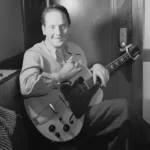
Les Paul is a name most people know from a guitar. The Gibson Les Paul became one of the most famous electric guitars ever made. It has been played by Jimmy Page, Slash, Gary Moore, Peter Green, and other famous guitarists.
But who was the man behind this legendary instrument?
Quick Navigation
The Boy Who Heard the Future
Les Paul was born Lester William Polsfuss on June 9, 1915, in Waukesha, Wisconsin.
A railroad ran close to his childhood home.
One morning, when Les was about 10 years old, he was listening to a train from his bedroom. As the train passed, one of the windows began to shake.
Les put his hand against the glass. He could reduce the vibration, but he could not stop it completely. Then the sound of the train changed, and the window suddenly stopped shaking.
He wanted to know why.
The next day, he asked his physics teacher, Mr. Kahn, about it.
“That is called resonance.”
The explanation stayed with Les. Sound could make something else vibrate, even without touching it.
Les was the kind of child who wanted to find out how everything worked.
His family had a player piano. One day, his mother discovered that Les had punched extra holes into one of its paper rolls.
When she asked what he was doing, Les answered:
“I’m making him better.”
The extra holes made the piano play more notes at the same time.
Music came easily to him too. He received a harmonica for his ninth birthday and learned to play it within hours. Later, he saved enough money to buy his first guitar.
Before long, Les was singing, playing guitar, and switching to harmonica during the same performance. He called his little one-man act “Red Hot Red” because of his red hair.
As a teenager, he sometimes played at a local barbecue stand. Customers sat in their cars while Les performed.
One day, a waitress came over with a complaint from the people parked farther away.
“They can’t hear you in the back.”
Les went home and started thinking.
He noticed that the receiver from a telephone vibrated in a way similar to a radio speaker. He attached the telephone receiver to a broomstick, connected it to a radio, and made himself a simple microphone.
It worked. People could hear his voice.
But now they complained that they could not hear the guitar.
So Les started working on that problem too.
He took a needle from a record player and attached it to his guitar. Then he connected it to another radio and used the radio to amplify the sound.
It was a very crude setup, but suddenly his guitar was louder.
Les had discovered another problem, however. Hollow guitars could begin to vibrate when they were amplified, creating unwanted feedback.
He started experimenting with different materials.
At one point, he stretched a guitar string over a piece of railroad track and amplified it. The result surprised him. The heavy solid metal did not vibrate like the body of a hollow guitar, and the string produced a long, clear sound.
A railroad track was obviously not going to make a very practical guitar.
But the idea stayed with him.
How Les Paul Became a Guitarist
At 17, Les met country guitarist Sunny Joe Wolverton.
Sunny Joe heard him play and invited the young guitarist to perform with him. Les left school and began traveling as a professional musician.
Around this time, he started using another stage name: “Rhubarb Red”.
In the early 1930s, Les moved to Chicago.
There he could play country music on the radio as Rhubarb Red and jazz under the name Les Paul.
Jazz became a big part of his life. Les listened to other guitarists whenever he could and spent hours practicing his own playing.
In the mid-1930s, he formed the Les Paul Trio with bassist Ernie Newton and guitarist Jimmie Atkins, the older half-brother of Chet Atkins.
Les was now making his living with a guitar.
He also treated the instrument almost like a member of the family. Every night before going to bed, he cleaned his guitar and placed it where he would see it as soon as he woke up.
But playing music was never enough for him.
Les was a night owl, and after everyone else had gone home, he still wanted to play.
So he started thinking about how he could play with himself.
He had already built his own recording machine from whatever parts he could find. It included the flywheel from an old Cadillac, a belt from a dental drill, and parts from a jukebox.
Les began experimenting with recording more than one guitar part.
Records were made by cutting a groove into a disc. Les found that he could cut another groove between the first one and use two needles to play both recordings at the same time.
Now one guitarist sounded like two.
Then he built a second recording machine. He recorded one guitar part, played it back, added another part, and recorded everything onto the second machine. Then he did it again. Soon one Les Paul could sound like an entire group of guitarists.
He took the idea to record companies. They were not impressed.
“A nice trick, nothing more.”
Les kept experimenting anyway.
New York Star
In the late 1930s, Les moved to New York.
During the day, he played with Fred Waring and the Pennsylvanians on national radio. At night, he went to Harlem and played jazz.
His reputation as a guitarist grew quickly.
During World War II, Les worked for the Armed Forces Radio Service, making music and radio programs for American troops.
He later moved to Los Angeles, where his career became even bigger.
Les began working with Bing Crosby, one of the biggest stars in America. In 1945, he played guitar on Crosby‘s recording of “It’s Been a Long, Long Time”, which reached number one.
But Les was still thinking about recording.
At the time, making a record usually meant putting all the musicians together in one room and recording everything at once. If somebody made a serious mistake, everyone had to start again.
Les was convinced there had to be a better way. He turned the garage behind his Hollywood home into his own recording studio.
It was hardly a glamorous place. At first, it did not even have a proper door. But musicians and entertainers came there to record, and Les finally had a place where he could experiment for as long as he wanted.
The garage gave Les the freedom to experiment for as long as he wanted. He tried different microphone positions and recording speeds, played with echo, and found new ways to record one guitar part over another.
By 1947, Les had created a sound that was very different from anything else on the radio.
One of the best examples was “Lover”.
Les recorded one guitar part onto a disc. Then he played along with it and recorded both parts onto another disc. He repeated the process again and again. The final recording contained several Les Paul guitar parts, all played by the same man.
He also changed the speed of some of the recordings, which made certain guitar parts sound faster and brighter.
Les had made plenty of unusual recordings by then, but record companies still kept turning him down.
One day, he noticed workers putting up a new Capitol Records sign on a building. With some demos under his arm, Les walked inside and eventually found his way to the office of vice president Jim Conkling.
“Do you want to listen to one of my records?” Les asked.
Conkling agreed.
Les put a record on. The room filled with guitar sounds unlike anything Conkling had heard before.
“How many records like this do you have?” he asked.
“A lot,” Les said. “This is the worst.”
Conkling pulled out a pen and wrote a few lines on the back of an envelope.
“Sign it,” he said.
Les had finally found a record company that understood what he was doing.
“Lover” was released in 1948 and became a hit. The recording moved from warm low notes into layers of fast guitar lines and used effects such as echo and reverberation that sounded very unusual at the time.
Les was now more than a respected guitarist. He was becoming a recording star with a sound that people immediately recognized.
A Fateful Accident
Just as Les‘s career was taking off, a terrible accident nearly ended it.
In 1948, Les was traveling with a young singer named Colleen Summers. The roads were icy. Their car slid from the road and crashed below a bridge.
Les was badly injured.
His right arm and elbow were damaged so badly that doctors were not sure they could save them. At one point, amputation was even discussed.
For Les, there was one question that mattered more than anything else.
Could he still play guitar?
“I’m a guitarist,” Les had told the doctors. “If my arm needs to be secured in one position, then please this way.”
The doctors did exactly that. His arm never moved normally again, but Les could still play.
Recovery took a long time.
“The accident actually improved my technique,” he joked later. “It forced me to omit unnecessary movements of the elbow.”
Colleen stayed close to him, and their relationship grew during those difficult months. She also became part of his musical career. Les thought she was a great singer, but he did not think Colleen Summers was the right name for their act.
“There is only one problem – Your name,” he said.
When Summers asked how she was to be named, Les opened a phone book and said, “Mary Ford.”
Les and Mary married in 1949.
Together, they became one of the biggest musical acts of the early 1950s.
Their records sounded unusual because Les used his recording experiments on almost everything they made.
He could add several guitar parts to one song. Mary’s voice could also be recorded several times, making one singer sound like a whole group.
“How High the Moon” reached number one in 1951.
“Vaya Con Dios” became another huge hit in 1953.
Les Paul and Mary Ford sold millions of records. They appeared on radio and television and performed for audiences across America.
At the same time, another part of Les Paul’s life was about to become just as famous as his music.
The Gibson Les Paul
Les had been experimenting with solid-body electric guitars for years.
He had tried hollow wood, solid wood, steel, aluminum, and almost anything else he thought might produce the sound he wanted.
In 1941, while living in New York, he was allowed to use the Epiphone factory on Sundays. There he built his most famous experimental guitar.
At the center was a solid block of wood with a neck, strings, and pickups attached to it.
Les called it “The Log”.
It sounded good. It looked terrible.
People were used to guitars with beautiful wooden bodies. Les’s new instrument looked more like a piece of lumber with strings attached.
So he cut an Epiphone guitar body into two pieces and attached the sides to The Log. Now it looked more like a normal guitar.
Les showed his idea to Gibson, but the company was not interested. A guitar with a solid wooden body still seemed strange.
“There was no thought that Gene Autry, the popular country singer, was going to play on something that looked like railway sleepers!” said Les.
For years, nothing happened.
In the early 1950s, another American guitar company, Fender, was having great success with the Telecaster. Gibson decided to develop a solid-body electric guitar of its own.
Ted McCarty, who was running Gibson at the time, met Les and Mary in Pennsylvania and showed them a prototype. Les had already spent years experimenting with solid-body guitars and had plenty of ideas of his own.
He and Gibson began working together on the new guitar.
Les suggested changes and also wanted to use a bridge and tailpiece design he had been developing.
That night, Les, McCarty, and Les‘s manager worked out an agreement.
The new guitar would carry the Les Paul name, and Les would promote it.
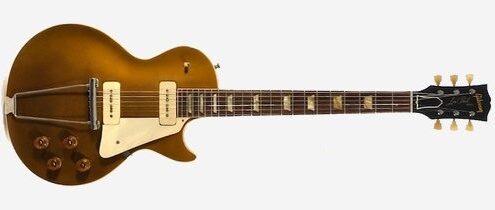
In 1952, the first Gibson Les Paul went on sale. The guitar had a mahogany body with a carved maple top, two P-90 pickups, and a gold finish.
That first version became known as the Goldtop.
The Les Paul changed several times during the 1950s. Gibson improved the bridge and later added humbucking pickups, which gave the guitar a thicker sound with less electrical hum.
In 1958, Gibson introduced the sunburst Les Paul Standard.
Today, the late-1950s Les Paul Standards are among the most valuable electric guitars ever made.
Strangely, they were not especially successful when they were new. Sales fell, and Gibson stopped making the original Les Paul design after 1960.
Then guitar music changed.
During the 1960s, players such as Eric Clapton and Peter Green discovered the sound of the older Les Pauls. Jimmy Page later helped make the guitar one of the great instruments of rock music.
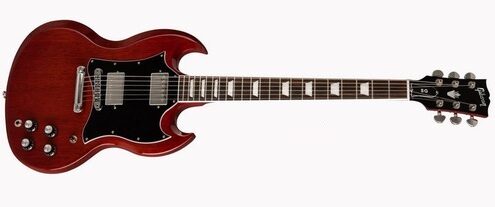
By then, Gibson had already replaced it with a completely different guitar. The new model had a thin mahogany body, two deep cutaways, and a much lighter design.
At first, it was still sold with the Les Paul name. But Les did not like the new guitar and he asked Gibson to remove his name.
The model later became the SG, short for “Solid Guitar”.
Ironically, the SG became another Gibson classic.
Demand for the old-style Les Paul also continued to grow. In 1968, Gibson brought the original design back.
It has been one of the company’s most famous guitars ever since.
Les Paul’s Inventions That Changed Recording
The Gibson guitar made the name Les Paul famous to later generations of guitarists.
But Les was still just as interested in recording.
His early experiments had been done with discs. Every time he added another guitar part, he had to record the old parts and the new part together again.
It worked, but it was difficult.
“Instead of covering the entire width of the tire, let’s put the heads one above the other and record on multiple tracks,” he said.
After World War II, new tape recording technology began appearing in the United States. Bing Crosby was one of the people who quickly saw its potential and helped support its development.
Les got his hands on an early Ampex tape recorder. Naturally, he did not leave it alone. He began changing the machine.
Les added another recording head so he could listen to something he had already recorded while adding a new part.
Now he could build a song layer by layer on tape.
A guitar part could be recorded first. Then another guitar. Then a voice. Then another voice.
This became known as sound-on-sound recording.
Les and Mary Ford used it constantly on their records.
But Les wanted something even better. With sound-on-sound, the earlier parts were combined each time something new was added. Once they were mixed together, it was difficult to change them separately.
Les wanted each sound to have its own track. His idea was to divide the tape into several separate recording tracks.
A guitar could be on one track. A voice could be on another. Another guitar could be somewhere else.
Later, all the tracks could be played together and mixed.
Les worked with Ampex to develop the idea. In 1957, he received an eight-track recorder built for his studio.
It completely changed what was possible.
A musician no longer had to record an entire performance at once. Different parts could be recorded at different times and then combined later.
Today, that seems completely normal. At the time, it was revolutionary.
Les continued experimenting with recording equipment for the rest of his life.
His marriage to Mary Ford ended in the 1960s, but the two remained friends.
In the 1970s, Les returned to the studio with another great guitarist, Chet Atkins. Their album “Chester & Lester” won a Grammy in 1977.
Les was getting older, but he still stayed up late working on new ideas.
His house in New Jersey became packed with guitars, recording equipment, electronic parts, and old machines he had kept for years.
He continued thinking about the future of recording too. Long before digital recording became normal, Les was already wondering whether music could be recorded without moving tape, discs, or other mechanical parts.
And he never stopped playing. In 1984, Les began performing every Monday night at Fat Tuesday’s in New York.
When the club closed, he moved his Monday-night shows to the Iridium.
Famous guitarists came to play with him. Young musicians came just to meet him. Fans who knew the Gibson Les Paul could finally see the actual Les Paul sitting a few feet away with a guitar in his hands.
He was inducted into the Rock & Roll Hall of Fame in 1988.
In 2005, at the age of 90, he was inducted into the National Inventors Hall of Fame.
He continued performing almost until the end of his life.
Lester William Polsfuss died in White Plains, New York, on August 12, 2009. He was 94 years old.
Today, his name is still written on one of the most famous electric guitars ever made. But the guitar was only one of the things Les Paul left behind.
Daniel Queen, chairman of the Technical Council of the American Association of Sound Engineering, says:
“Les Paul’s multi-track concept has not only influenced the way pop music sounds, it has also influenced serious music, from the recording of a Mahler symphony to the avant-garde music of composers such as John Cage.”
Pop guitarist Steve Miller summarized the career of Les Paul as follows:
“In addition to the fact that Les has sold millions of records and has fascinated his fans for over sixty years, he was the first with the talent and insight to combine music and technology.“
What Steve Miller and many other guitarists know is that every sound they make is the legacy of Les Paul’s talent. But almost no one can imagine that it all started with a boy, a train, and a vibrating window.
That was the day a child came into contact with music.
That was the day he heard the future.