Chord charts are one of the easiest ways to learn guitar chords. You can use them to play your favorite songs without reading standard music notation.
Quick Navigation
What Is a Guitar Chord?
A guitar chord is several notes played at the same time.
To play a chord, you hold down certain strings on certain frets and strum the strings together. Each chord has its own shape on the fretboard.
A chord chart is a picture of that shape.
The name of the chord is written above the diagram: C, G, D, Am, E7, and so on.
How to Read a Guitar Chord Chart
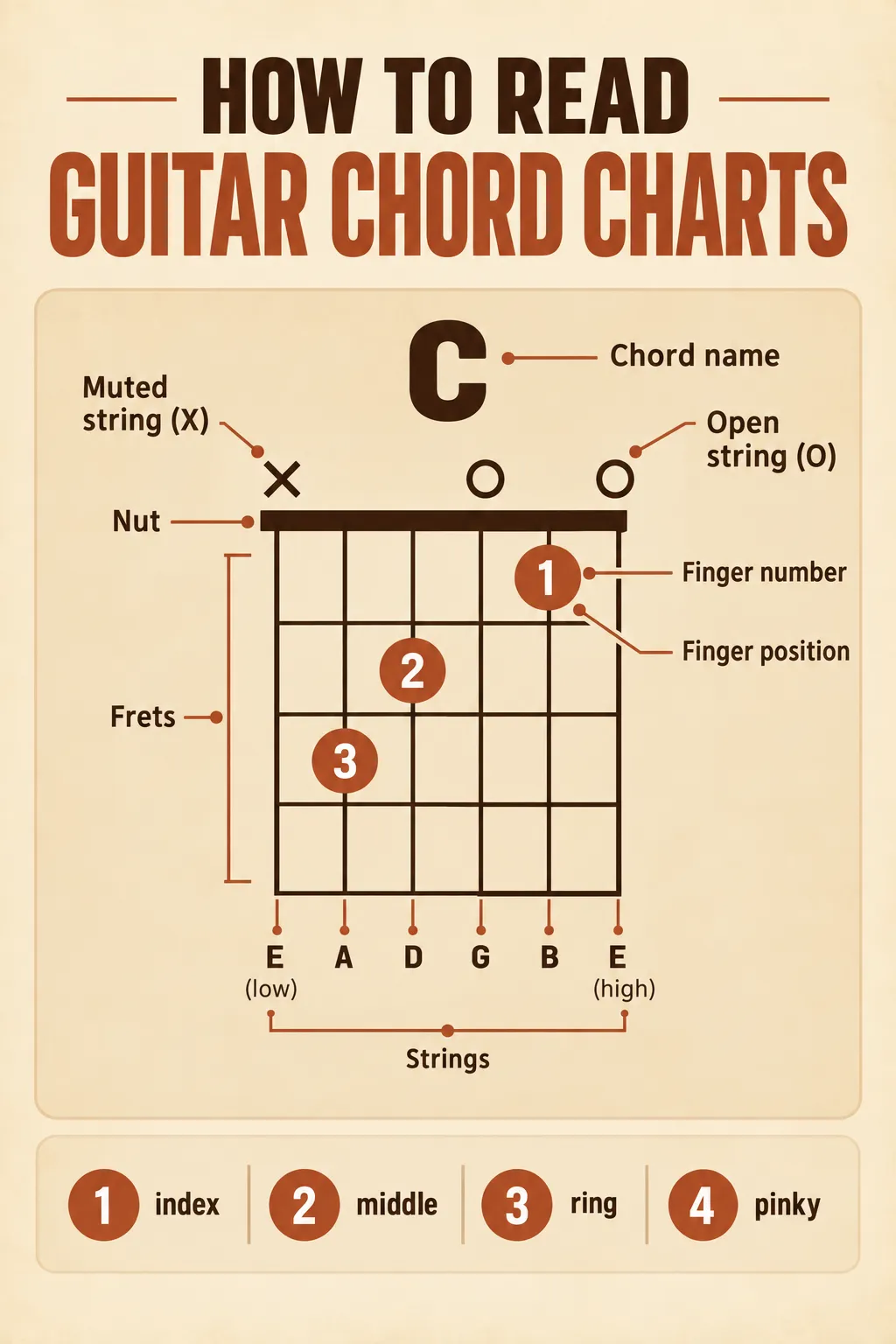
A chord chart shows a small part of the guitar neck from the front. Imagine the guitar standing upright with the strings facing you.
Strings
The six vertical lines are the six guitar strings.
From left to right:
Low E – A – D – G – B – High E
The low E is the thickest string on the guitar. The high E is the thinnest.
Frets
The horizontal lines show the frets.
The thick line at the top of many chord diagrams represents the nut, the part between the fretboard and the headstock.
The first space below it is the first fret. The next space is the second fret, then the third, and so on.
Dots and Finger Numbers
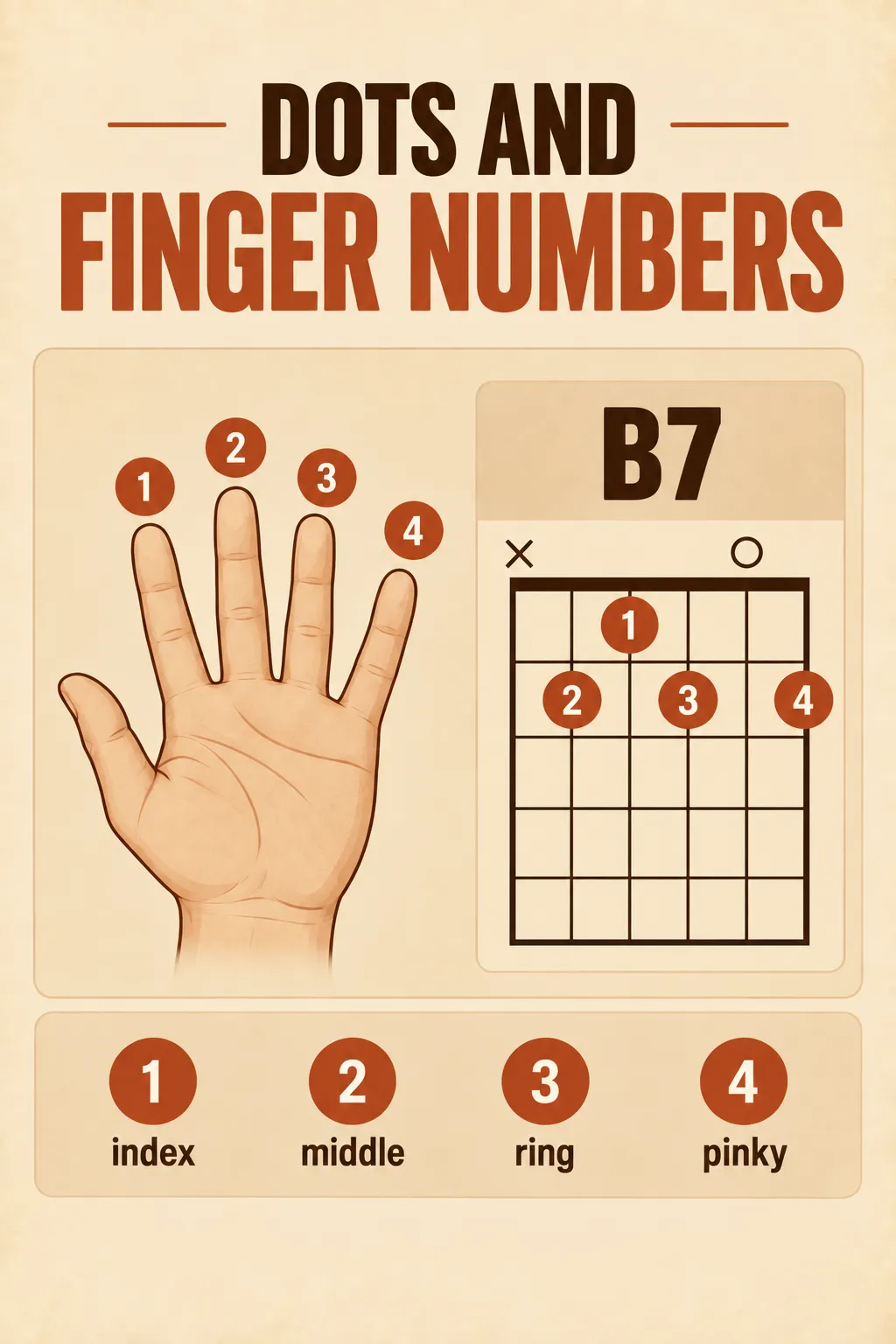
A dot shows where a finger goes.
Some diagrams put a number inside or next to each dot. The number tells you which finger to use:
1 = index finger
2 = middle finger
3 = ring finger
4 = pinky
X and O
The Xs and Os appear above the strings.
O = play the string open.
An open string is played without pressing it down at any fret.
X = do not play that string.
For example, if there is an X above the low E string, that string should not be part of the chord.
How to Play a Chord From the Chart
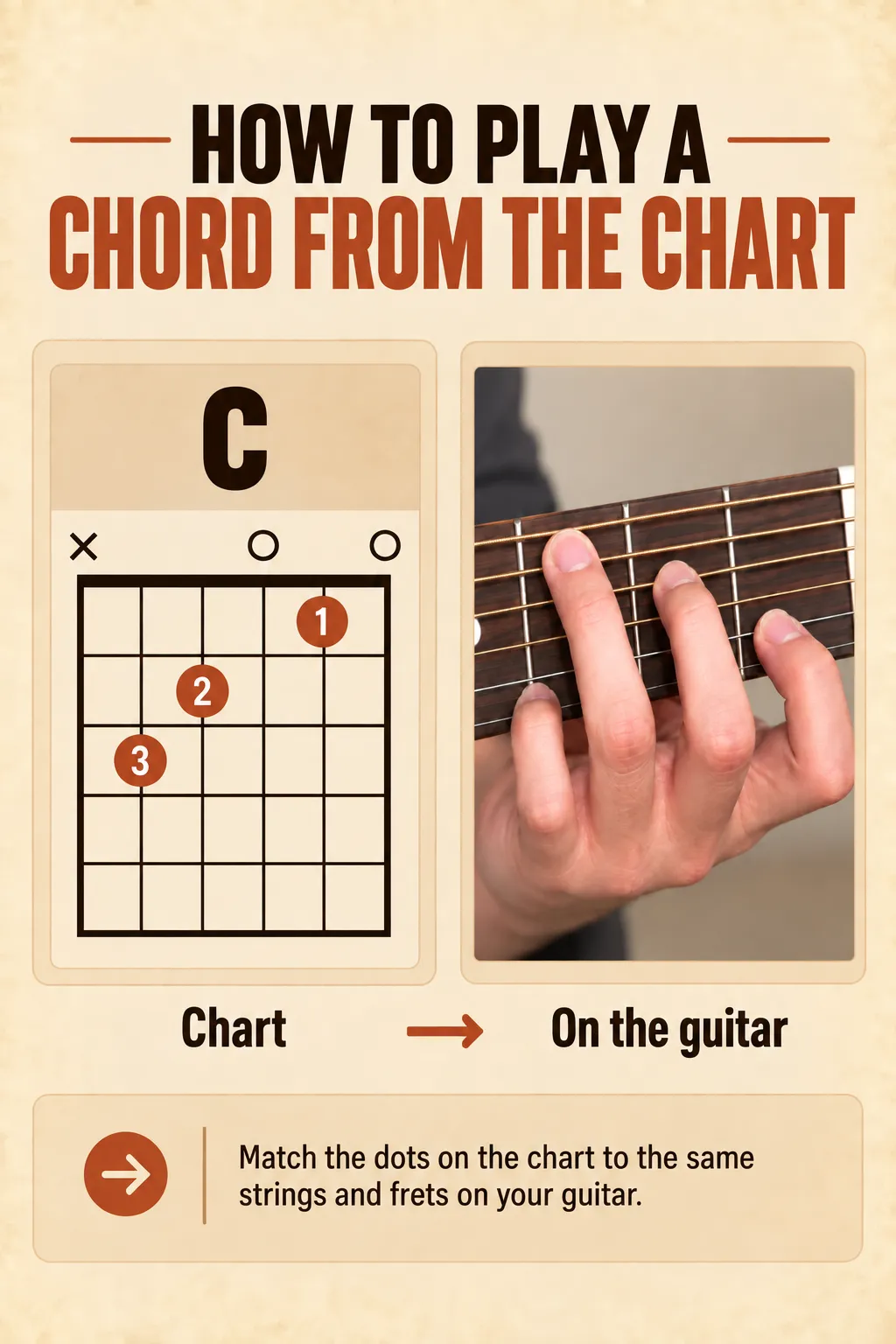
Match each dot on the diagram to the same string and fret on your guitar.
Place your fingertip just behind the metal fret, not directly on top of it. If the diagram shows finger numbers, use the finger marked for each note.
Strum the strings that belong in the chord.
Then play those strings one at a time. Each note should sound clear. If one sounds muted or buzzes, check the position of your fingers and move them slightly if needed.
Your First Guitar Chords
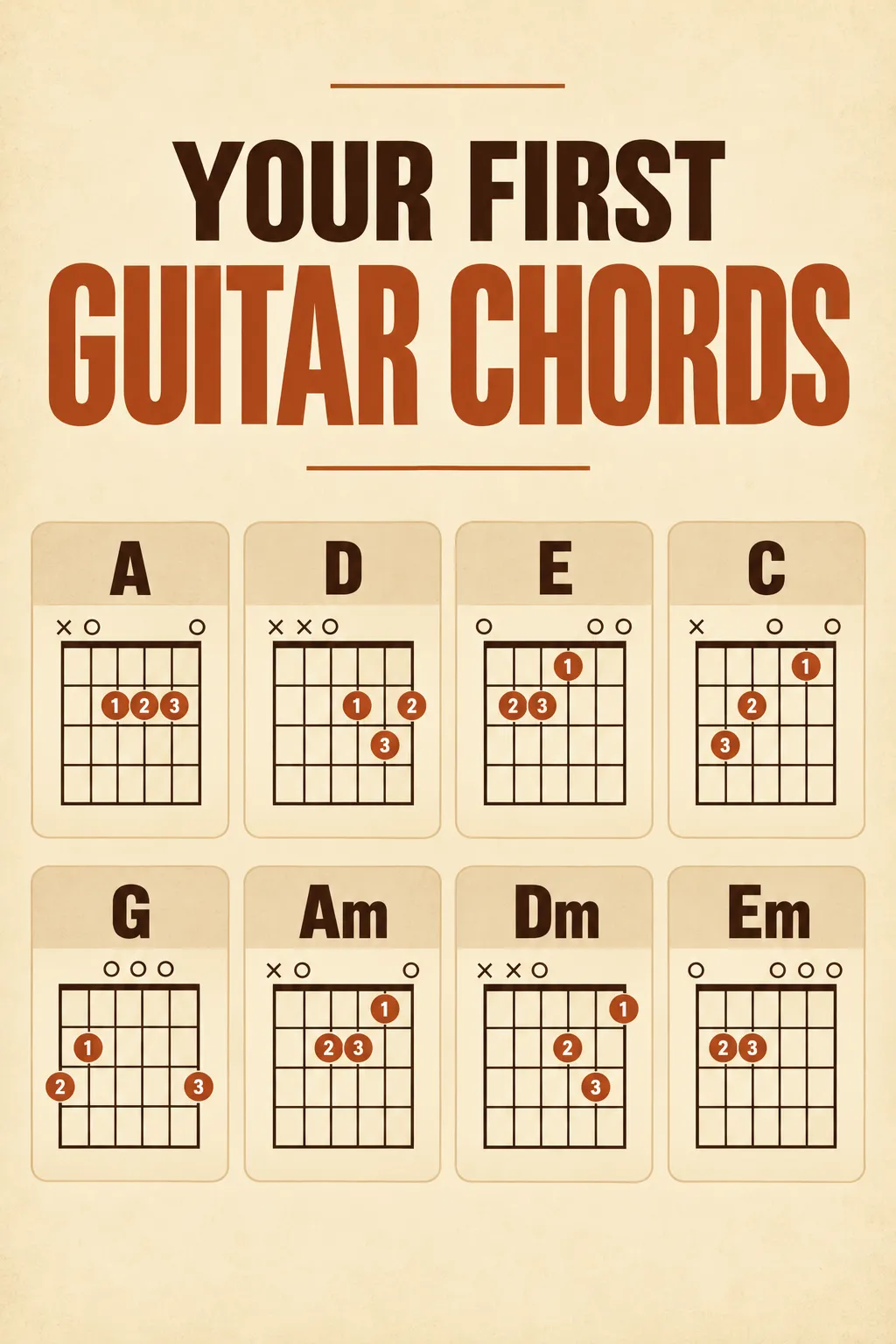
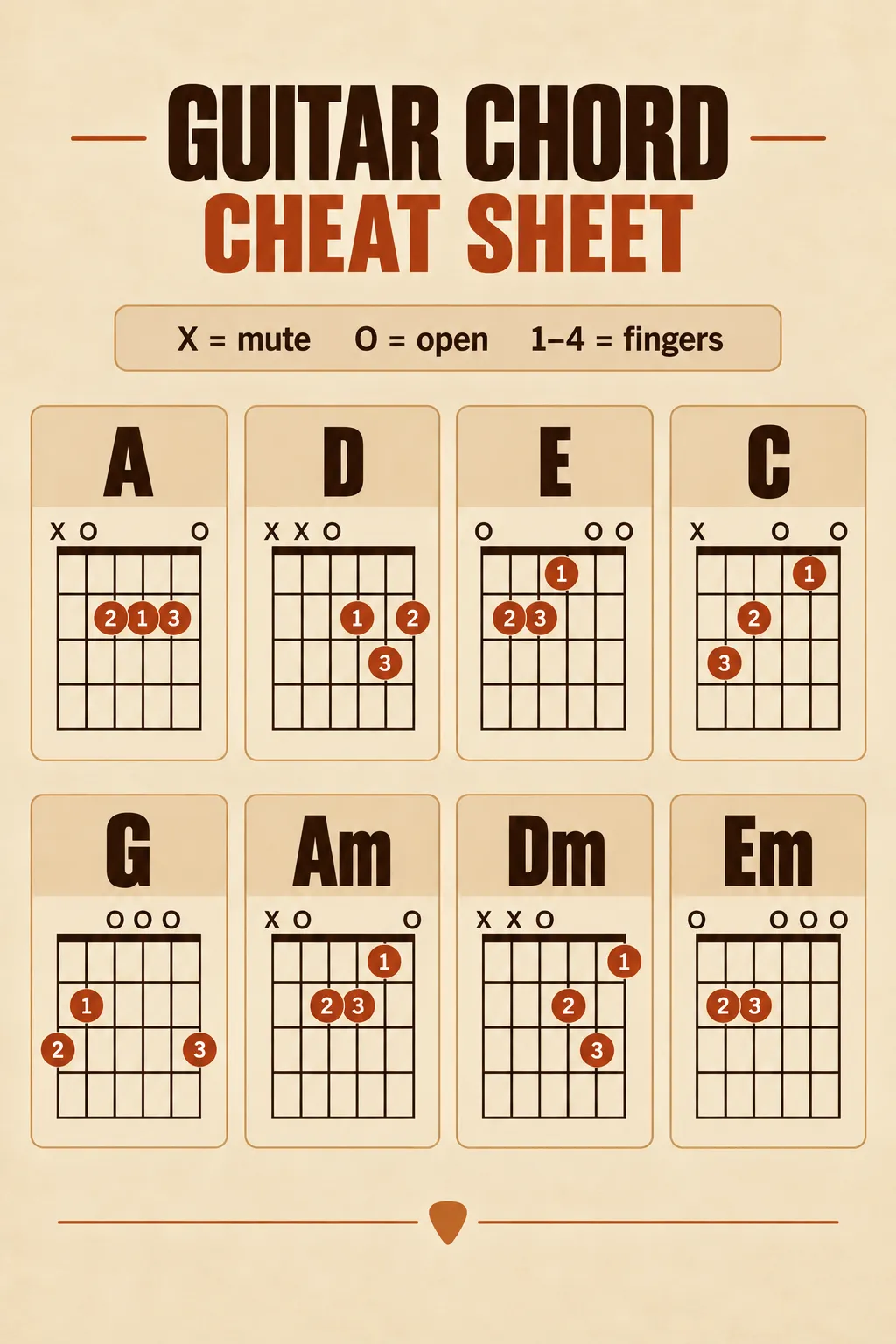
A good first set of guitar chords is:
A – D – E – C – G – Am – Dm – Em
These are open chords. An open chord includes one or more strings that are played without being pressed at a fret.
The small m means minor.
For example:
A = A major
Am = A minor
The same applies to D and Dm, E and Em, and other chords.
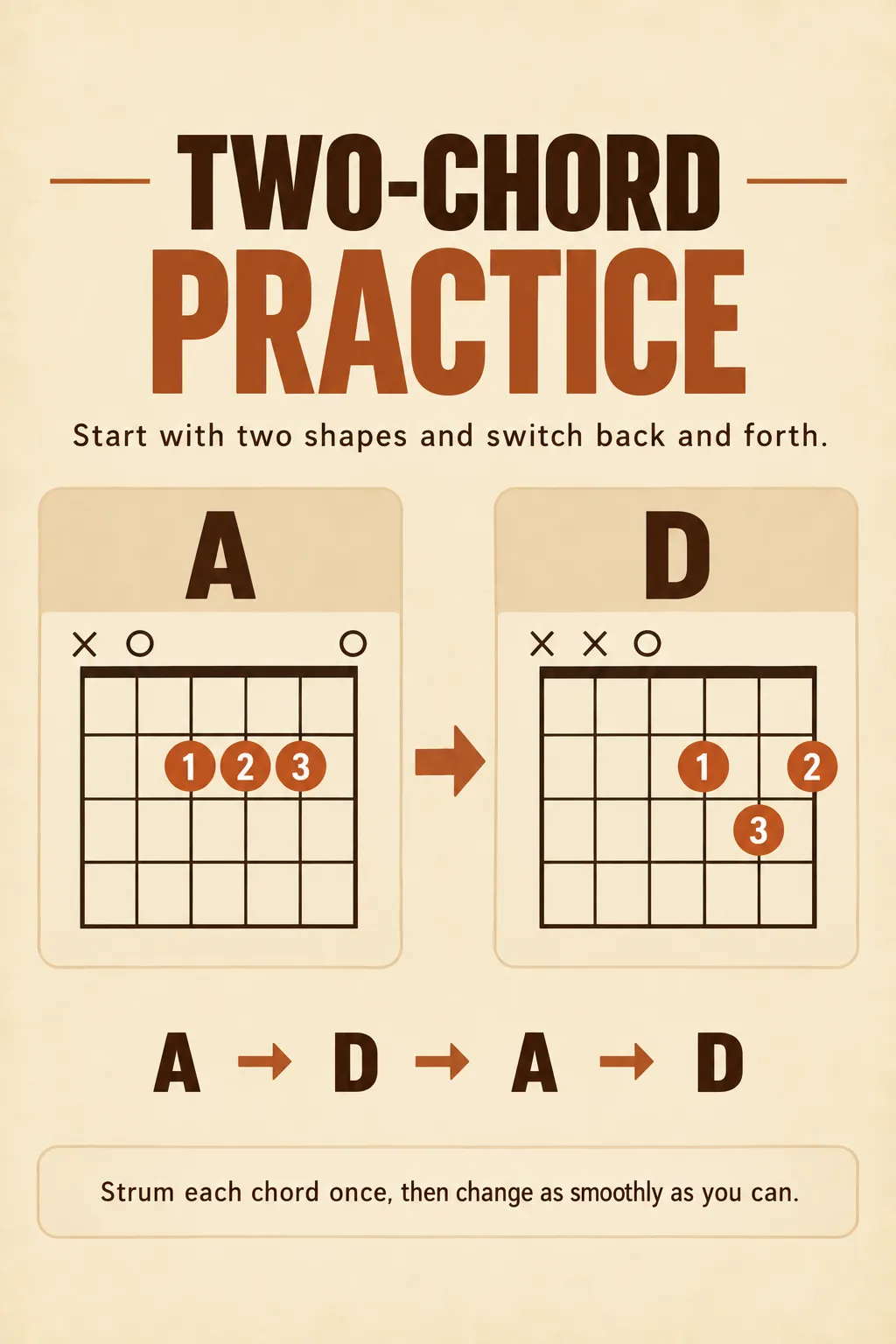
It is easier to practice two chords at a time than to remember eight new shapes at once.
Make one chord and strum it. Move to the second chord and strum again. When both chords sound clear, practice changing between them with as little pause as possible.
Easy Guitar Chords for Beginners
There is no reason to stop with the 8 basic chords. Many other guitar chords are just as easy to play.
Learning a few of them gives you more songs and more sounds to work with.
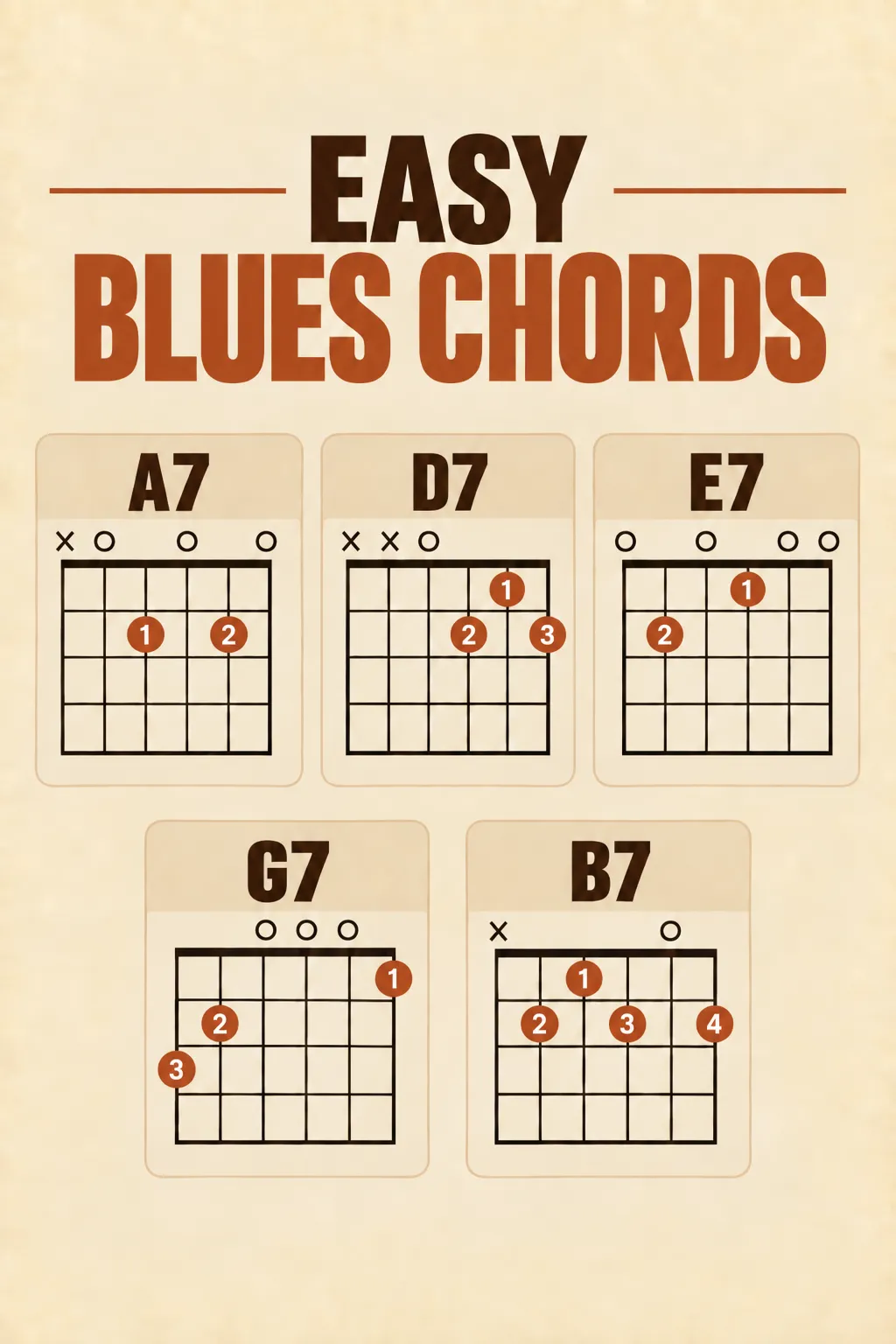
If You Want to Play Blues
A7 – D7 – E7 – G7 – B7
7th chords are very common in blues. The 7 is part of the chord name. It does not mean that you should play the 7th fret.
A 7th chord adds one more note to a basic major or minor chord.
A7 is a simple two-finger chord and is easier to play than a regular A major shape.
D7 is close to a regular D chord, with the fingers arranged a little differently.
E7 is almost the same as E – one finger comes off and the D string stays open.
G7 uses only three fingers, just like a basic G chord.
B7 uses four fingers, so it takes a little more practice.
Easy Chords You’ll Hear in Acoustic Rock
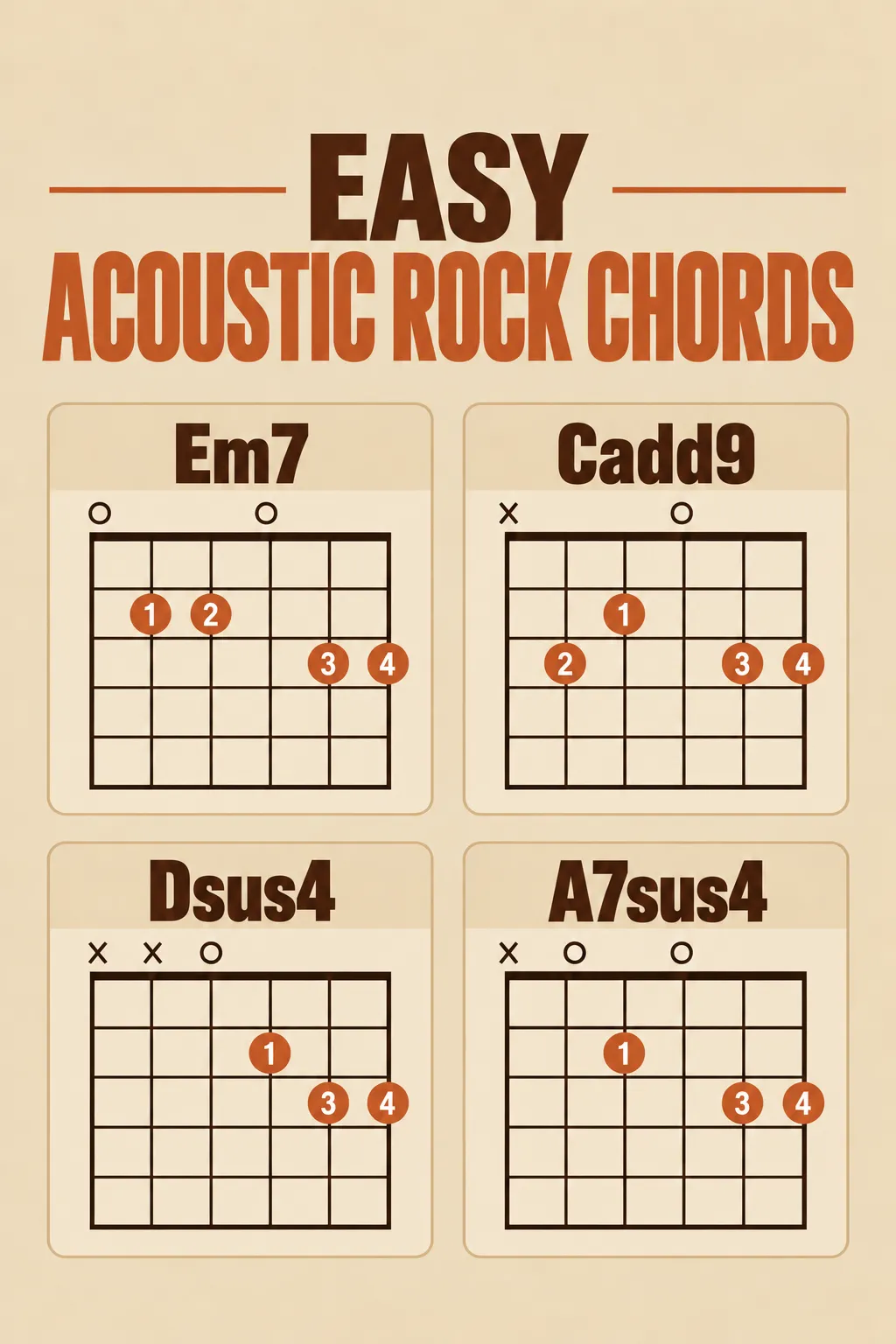
Em7 – Cadd9 – Dsus4 – A7sus4
The names may look more complicated than C or G, but these particular shapes are not especially difficult to play.
A well-known example is “Wonderwall” by Oasis. Its guitar part uses Em7, Cadd9, Dsus4, and A7sus4, along with a few other chords.
Em7 is based on the familiar Em shape and is very easy to play.
Cadd9 is close to G, so changing between the two chords is especially easy.
Dsus4 is almost the same as D – one finger moves to a different fret.
A7sus4 looks more complicated by name than it feels on the guitar. The open shape is easy to hold, especially next to chords such as Em7 and Cadd9.
Easy Chords Used in Soul and R&B
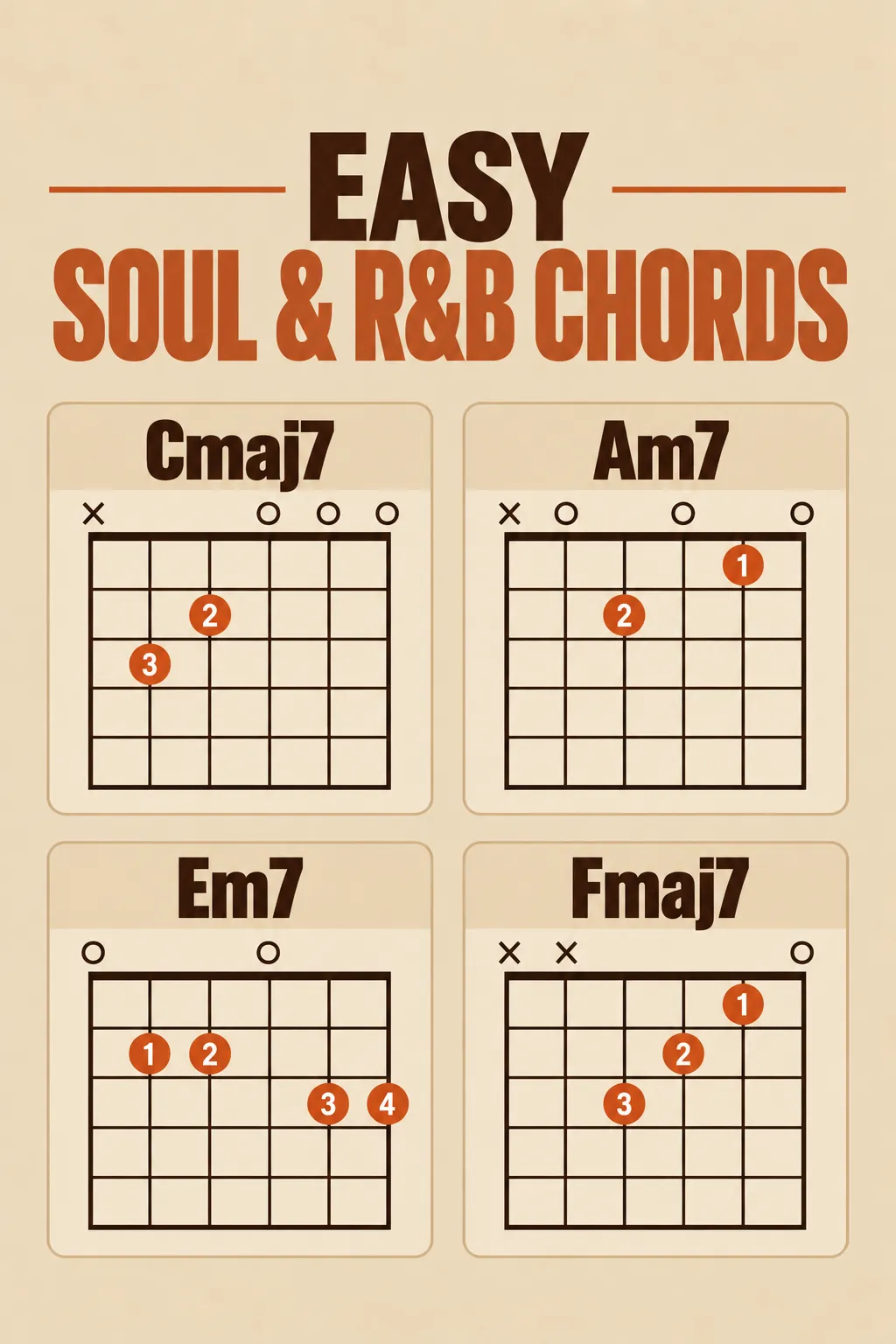
Cmaj7 – Am7 – Em7 – Fmaj7
Besides blues, 7th chords are also common in pop, soul, and R&B.
Cmaj7 is almost the same as C – just lift your index finger from the B string.
Am7 is Am without the finger on the G string.
Em7 can be played with just one finger on the second fret of the A string.
Fmaj7 uses three fingers: third fret on the D string, second fret on the G string, and first fret on the B string. Let the high E string ring open.
These chords are useful when regular major and minor chords sound a little too plain for the music you want to play.
Easy Chords for Folk
Asus2 – Asus4 – Dsus2 – Dsus4 – Esus4
These are called suspended chords, or sus chords for short. In a sus chord, one note from a regular major or minor chord is replaced by a nearby note.
Sus2 uses the 2nd note, while sus4 uses the 4th. This gives the chord a more open, slightly unfinished sound.
Many sus chords are small changes to basic shapes you may already know.
Asus2 is very close to A – one finger comes off.
Asus4 also starts from A, but one note moves higher.
Dsus2 is almost the same as D – lift one finger and let the high E string ring open.
Dsus4 is another small change to D, with one finger moving up one fret.
Esus4 is based on E and only needs one note to move.
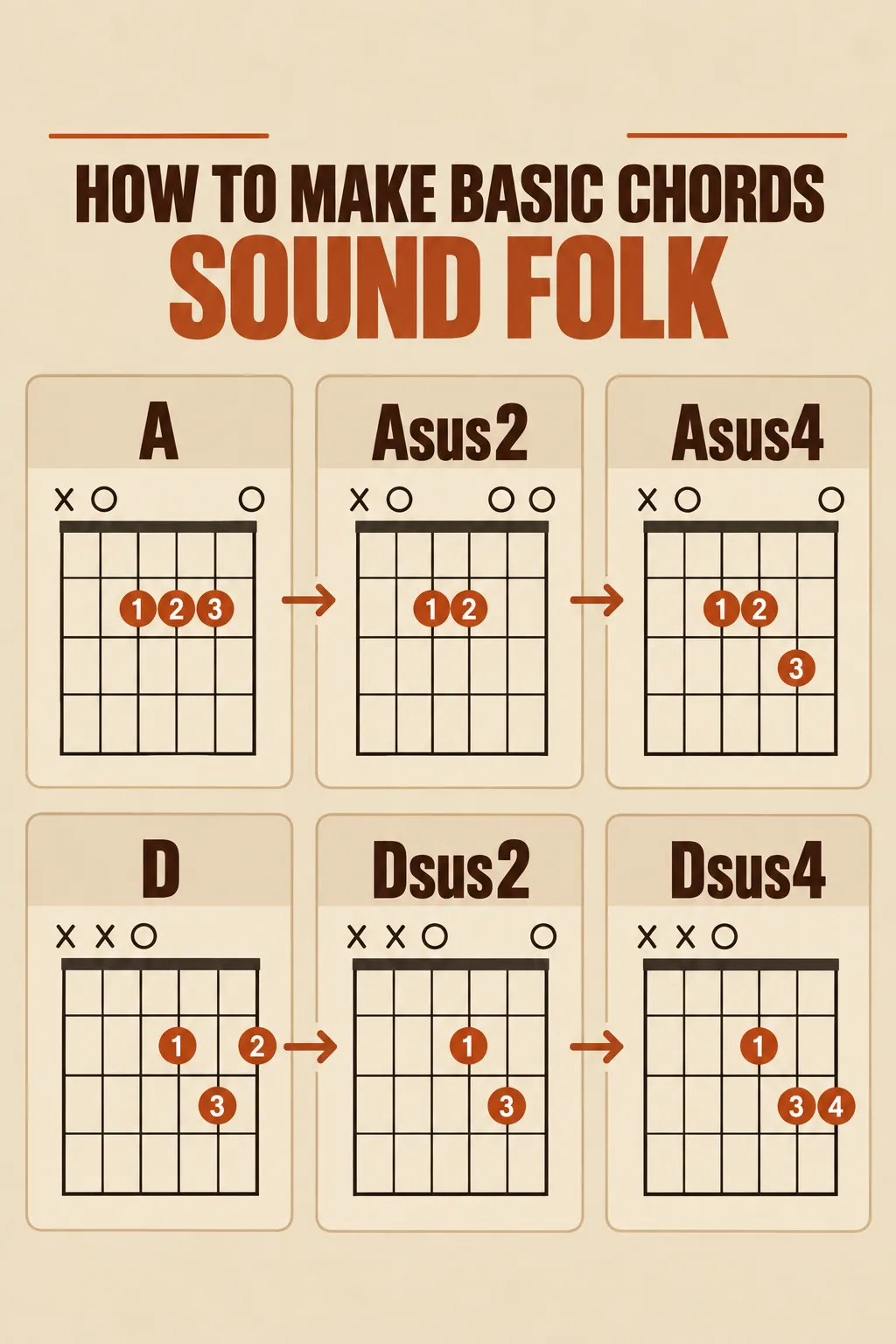
They are often used in folk, acoustic pop, and rock. A guitarist may move between a regular chord and a sus chord while the song stays on the same basic harmony.
Make Your Chords Sound Like a Song
To play a song, chords need to follow each other in an order.
For example:
G → D → Em → C
That order is called a chord progression.
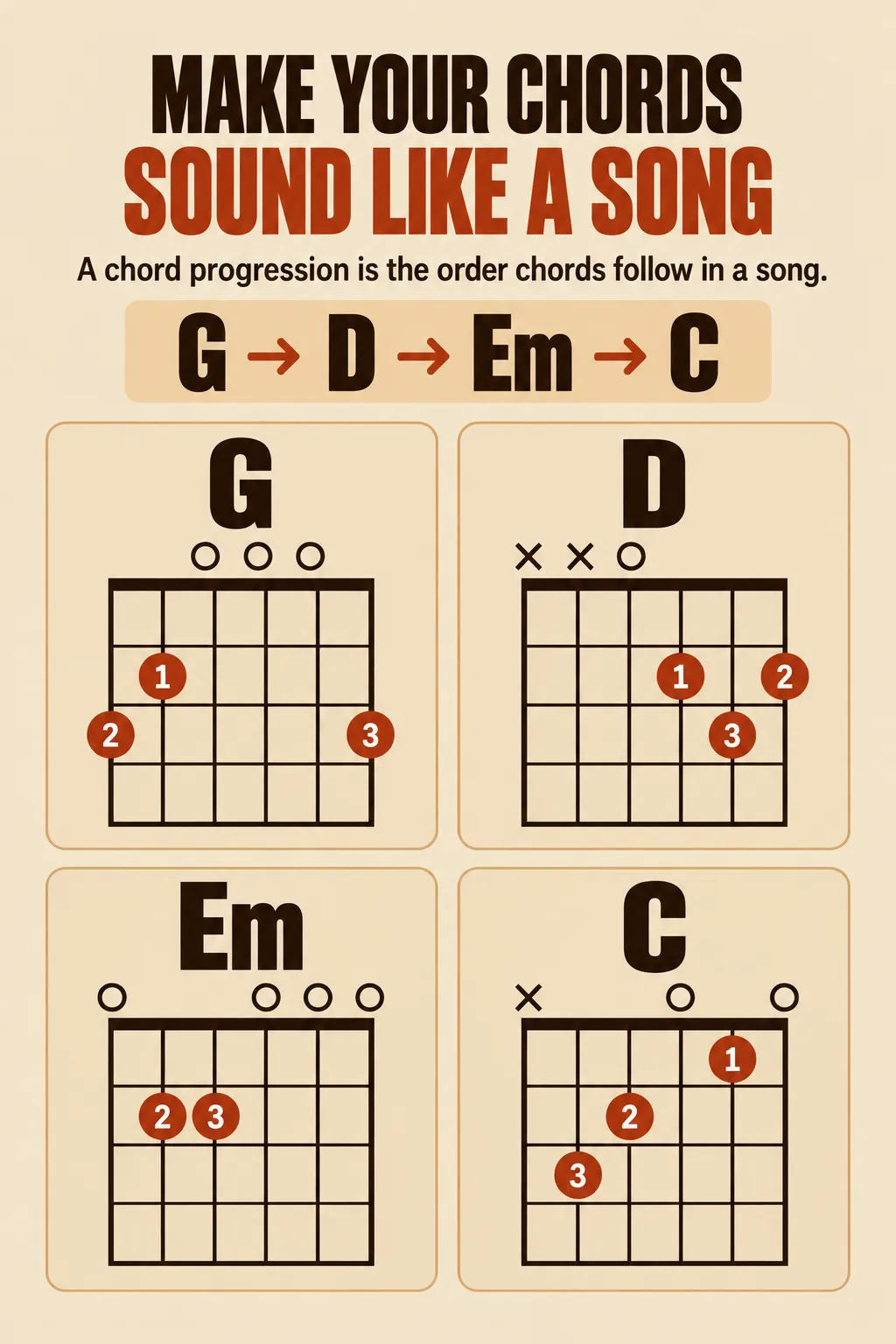
Play G, then D, then Em, then C.
Repeat the same order and keep the rhythm steady.
The chords can stay the same while the rhythm, melody, and lyrics change around them. This is one reason the same chord combinations can appear in many different songs.
Songs you can play with basic chords:
You do not need dozens of chords before you can play recognizable songs.
Here are a few examples that use simple open chords:
“Knockin’ on Heaven’s Door” by Bob Dylan
G – D – Am – C
“Bad Moon Rising” by Creedence Clearwater Revival
D – A – G
“Tush” by ZZ Top
G – C – D
These are simple chord versions of the songs. They give you the main chords without every riff and guitar part from the original recording.
Guitar Chord Types and How to Read Their Names
Basic chords are enough for many songs, but not for all of them.
Power chords are used a lot in rock and metal.
Barre chords often appear in pop and rock songs.
7th and 9th chords are especially popular in blues, soul, funk, and jazz.
You do not need to learn every type of guitar chord. But a favorite song may give you a reason to learn one of them.
Power Chords
Power chords are used in thousands of rock and metal riffs.
Their names usually end in 5:
E5 – G5 – A5 – C5
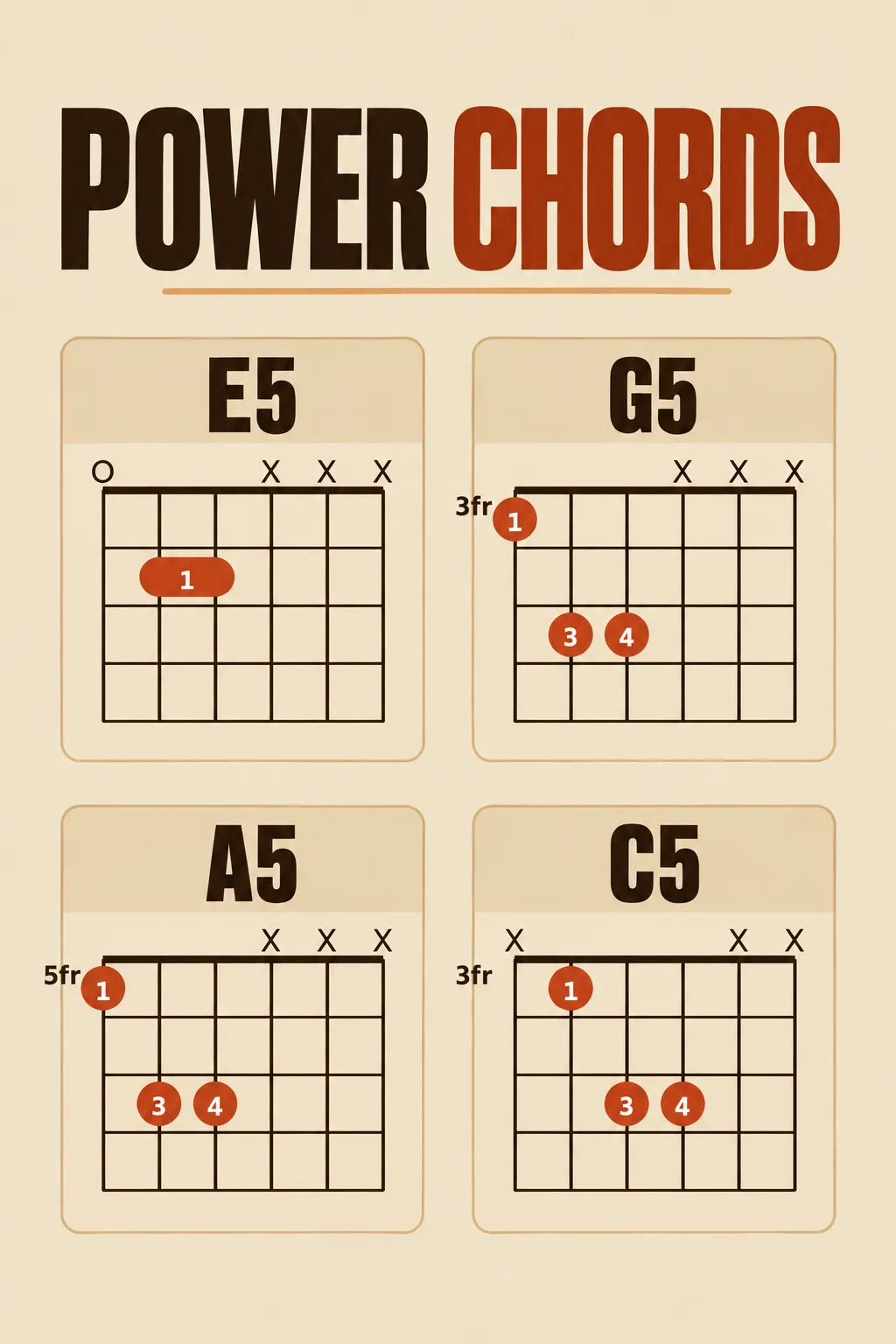
You can hear power chords in songs such as “Iron Man” by Black Sabbath and “Smells Like Teen Spirit” by Nirvana.
One advantage of power chords is that the same shape can be moved to different frets. Move the shape, and you get another power chord.
That makes them especially good for riffs.
Barre Chords
A barre chord uses one finger to press several strings at the same fret.
The main advantage is that the shape can move.
A shape played at one fret gives you one chord. Move the same shape higher or lower on the neck, and it becomes another chord.
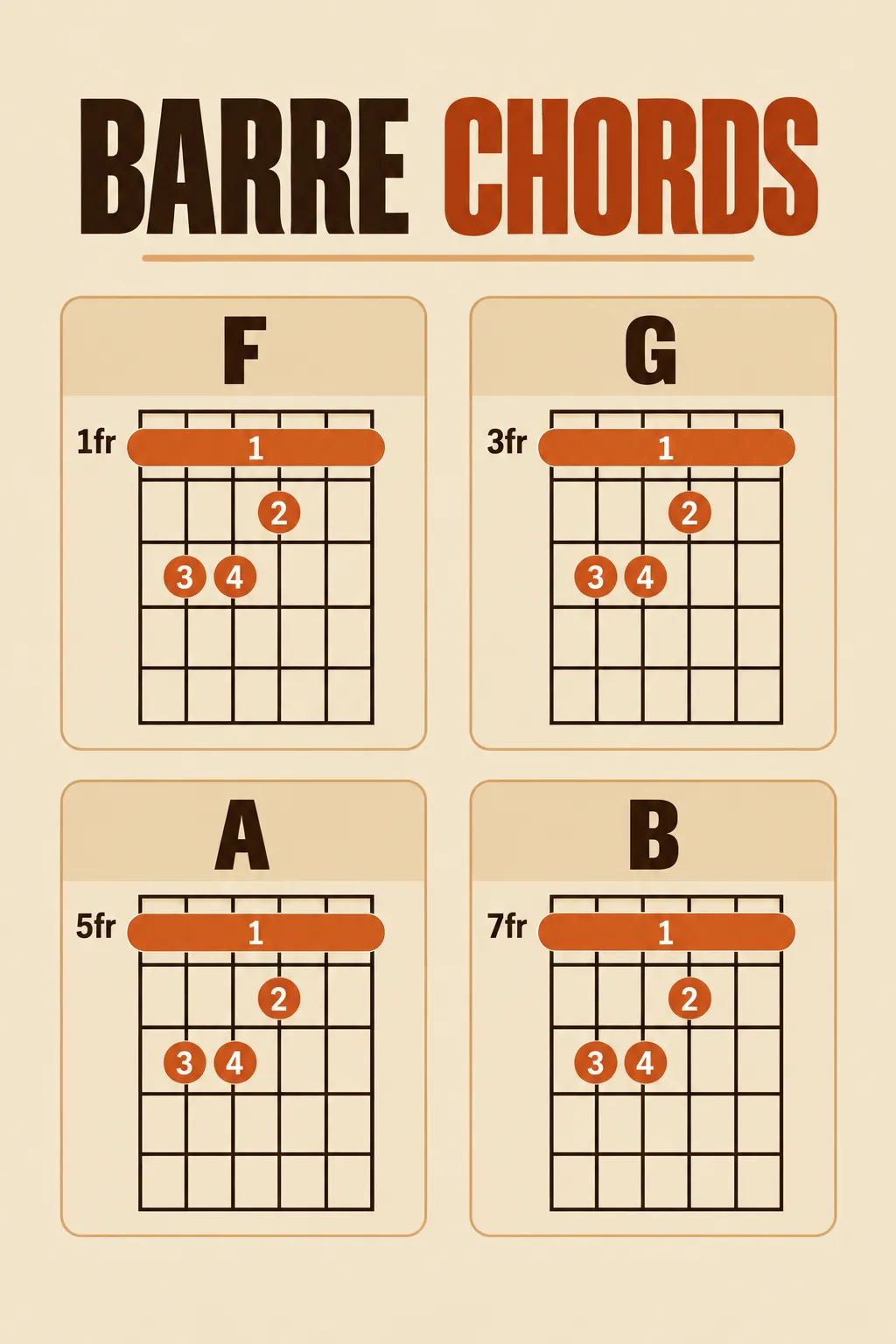
For example, Bm appears in songs such as “Enchanted” by Taylor Swift and “Shallow” by Lady Gaga and Bradley Cooper.
A common Bm shape uses a barre, so it may feel much harder than the first open chords.
Barre chords usually need more hand strength and cleaner finger placement. The basic open chords are much easier to learn first.
7th and 9th Chords
Blues often uses chords such as:
A7 – D7 – E7
Soul and R&B also use many 7th chords.
In funk, chords such as E9 and D9 are very common.
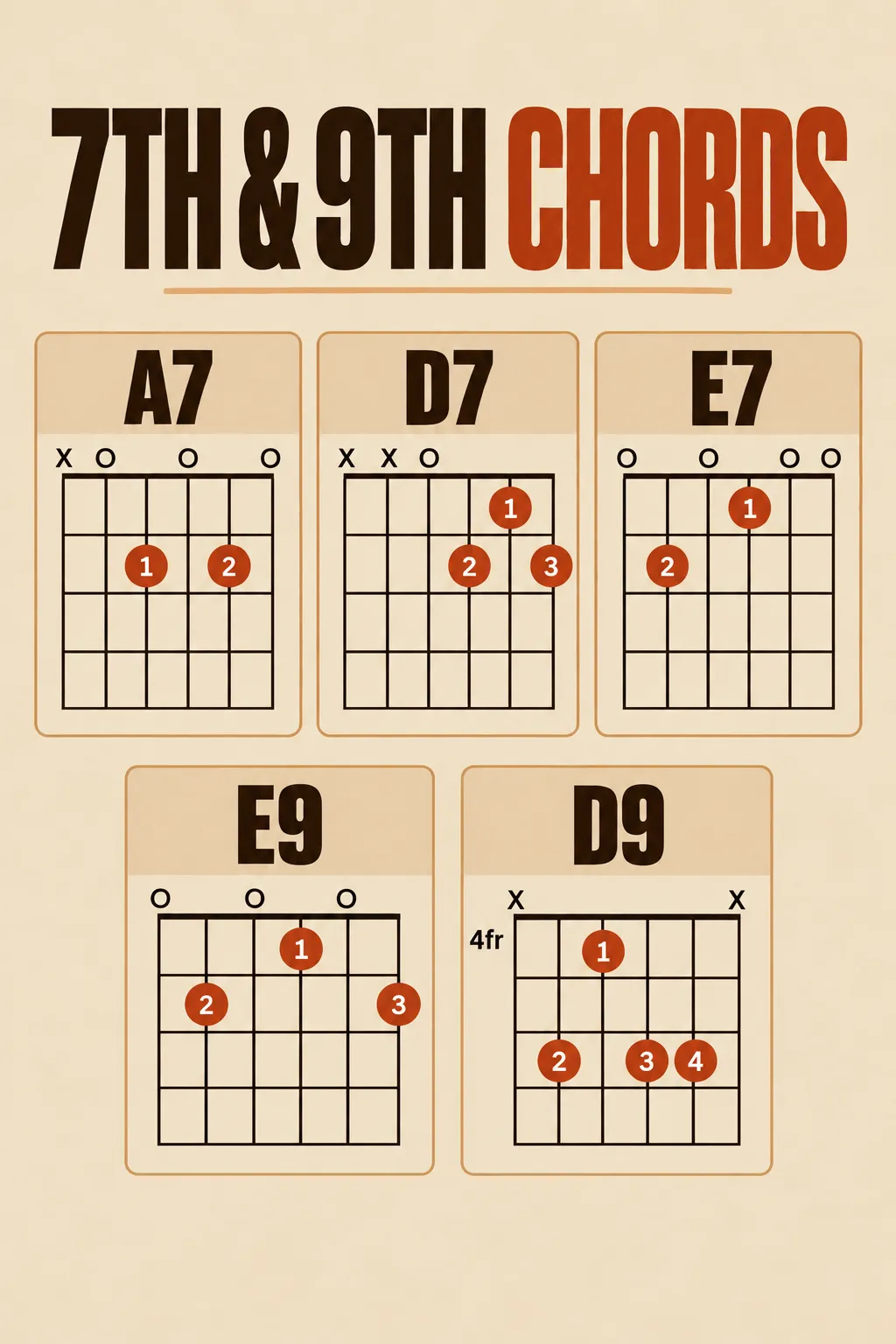
The numbers are part of the chord name. They tell you that the chord contains notes that are not part of the basic major or minor version.
Some of these shapes are easy. Others take more practice. The name alone does not tell you how difficult a chord will be on guitar.
Why Do Some Chords Have a Slash in the Name?
Sometimes a chord is written like this:
G/B
D/F#
These are usually called slash chords.
The first part is the chord name. The letter after the slash tells you which note should be the lowest note in the chord.
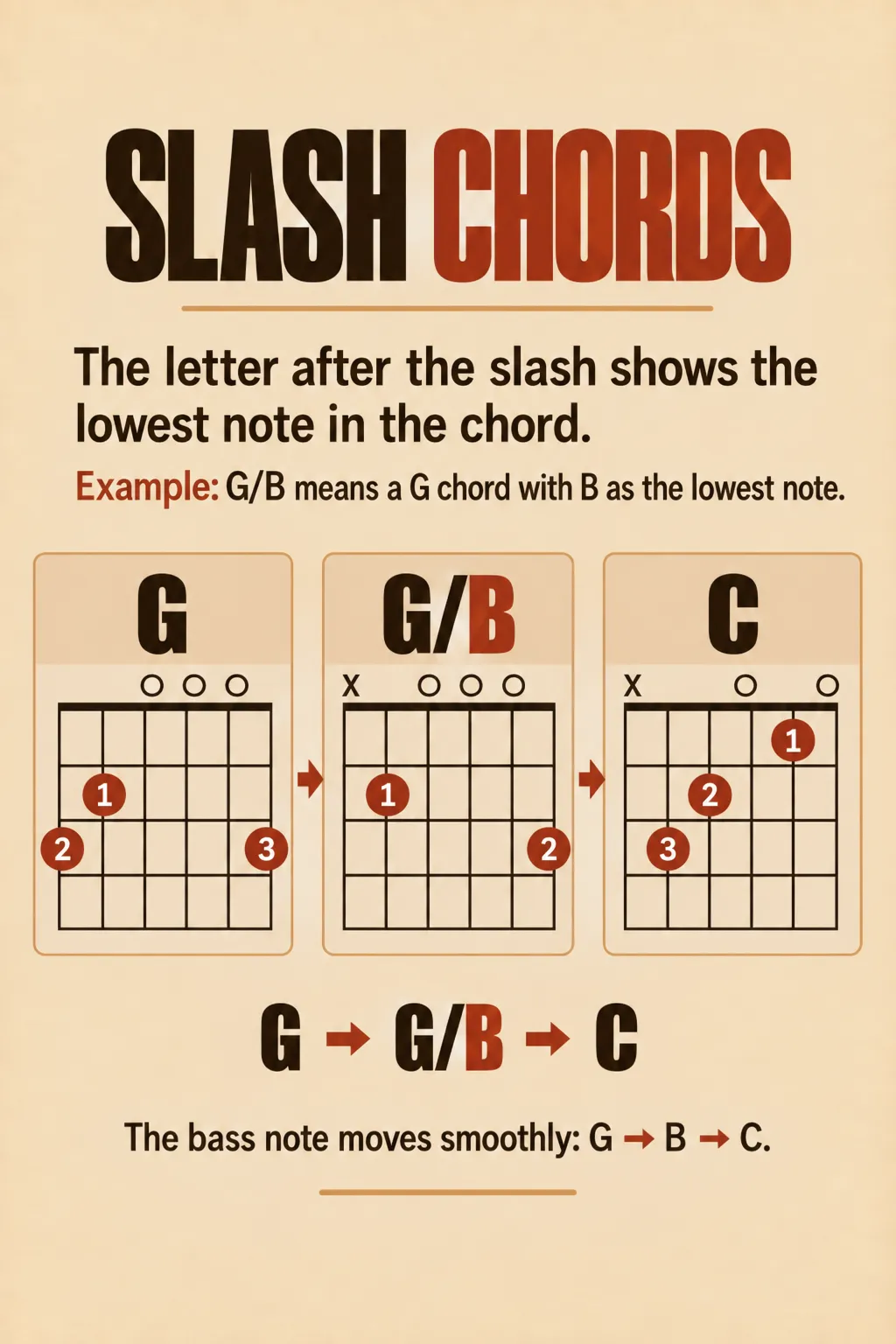
Slash chords are common in pop and acoustic music. They are often used to make the lowest notes move smoothly from one chord to the next.
What Do the Extra Letters and Numbers Mean?
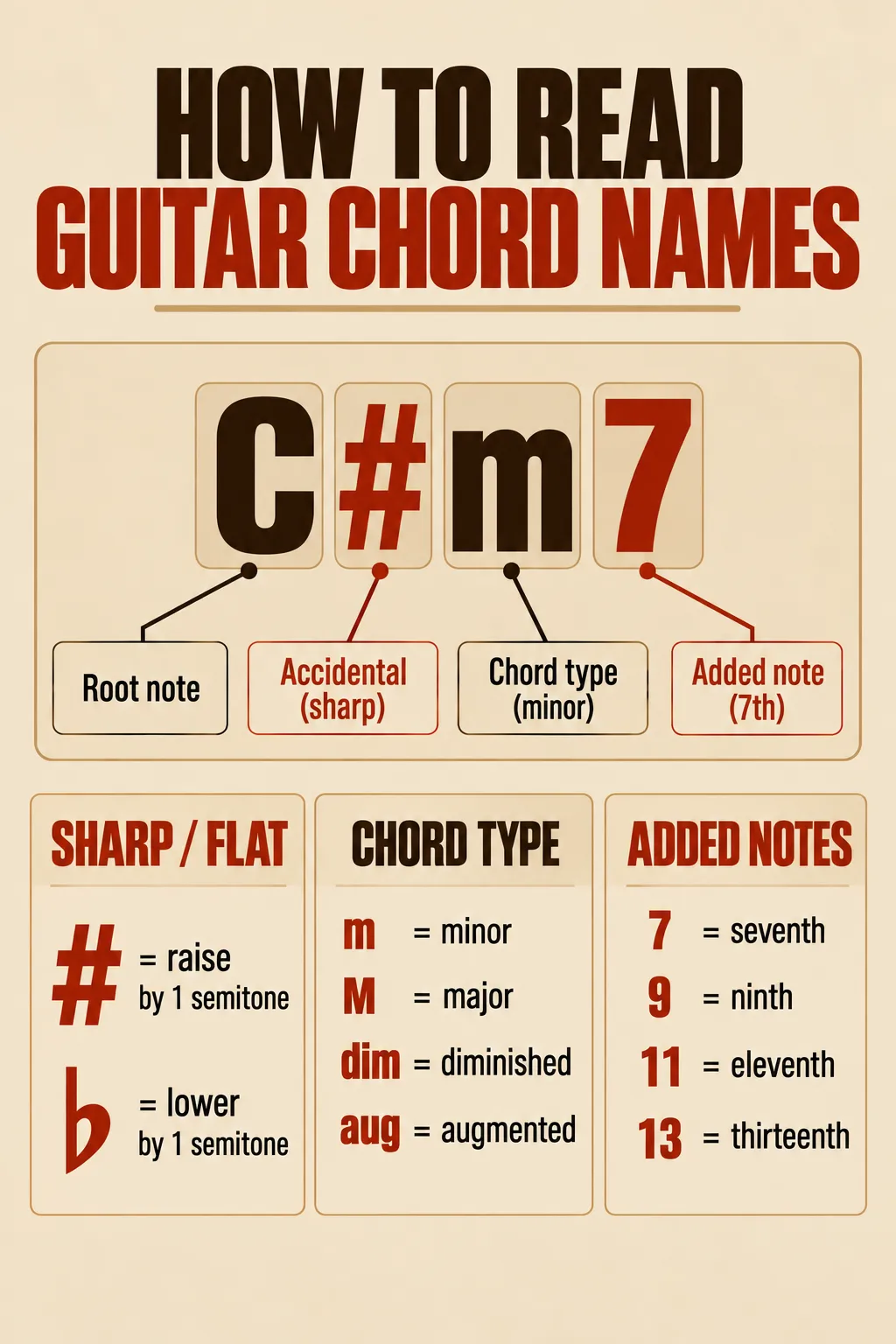
Chord names follow a system.
The first letter gives the main note:
A – B – C – D – E – F – G
Other letters and numbers tell you what kind of chord it is:
m = minor
7 = seventh
maj7 = major seventh
sus2 / sus4 = suspended chord
add9 = added ninth
A# means sharp and a b means flat.
So A, Am, A7, Amaj7, and Asus2 are all A chords, but they are not the same chord and they do not sound the same.
If you want to play a song, first find its chords on a chord or tab site. Then check which chords you already know and which ones are new.
Beginner Guitar Chord Cheat Sheet
A printed chord chart is useful when you are practicing and do not want to keep looking at a phone or computer.
Keep the basic chord shapes in front of you while you practice.
FAQ
How many guitar chords are there?
There is no single number. There are 12 root notes, many chord types, and many ways to play the same chord. Depending on what you count as a separate chord or shape, the number quickly reaches hundreds or thousands.
Why do I see different diagrams for the same guitar chord?
The same chord can be played in different places on the fretboard. For example, C major can be played as the familiar open C chord near the nut or with other shapes higher up the neck. Both can be correct C major chords even though the diagrams look different.
Do I need to read sheet music to use guitar chord charts?
No. A chord chart already shows where your fingers go on the fretboard. You can learn guitar chords without knowing how to read standard music notation.
Is a guitar chord chart the same as guitar tab?
No. A chord chart shows the finger shape for a chord.
Guitar tab shows what to play over time. The lines represent the strings, and the numbers show which frets to play.