
Gibson is mostly known for its electric guitars. But the company began long before electric guitars appeared.
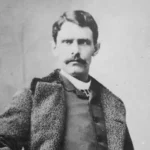
The story starts with Orville Gibson, a self-taught craftsmen who made guitars and mandolins in his spare time. His ideas about wood and guitar building later became the basis for the Gibson company.
Quick Navigation
Orville Gibson: From Singer to Guitar Maker
Orville H. Gibson was born in 1856 near Chateaugay, New York. He was the youngest of five children. His father, John W. Gibson, had come to the United States from England, while his mother, Amy Nichols Gibson, was from New York.
Orville loved music from an early age. He sang at local concerts and played guitar. He also liked carving wood and making things by hand.
As a young man, he moved to Kalamazoo, Michigan, where he found work as a clerk in a shoe store. In his free time, he began making mandolins and guitars. At first it was simply a hobby, but he soon started selling the instruments he made.
Orville had no formal training as an instrument maker. He learned by doing and developed his own methods.
He paid special attention to wood. Orville preferred well-seasoned “old wood” and believed it produced better instruments. He sometimes took apart old furniture or used wood from demolished buildings to get the material he wanted.
His instruments were unusual in both construction and materials. Orville took many of his ideas from violins. He carved the tops and backs from solid pieces of wood and gave them an arched shape instead of making them flat.
He also used tap tuning. While carving the wood, he listened to the sound it produced and adjusted the thickness until he was satisfied with the resonance.
Making instruments this way took a lot of time, but Orville’s guitars and mandolins began to attract buyers. One of his earliest known instruments is a 10-string mandolin-guitar from 1894. In 1898 he received a patent for his carved-body construction.
The Birth of The Gibson Company
Orville eventually reached the point where he could not make enough instruments on his own.
In 1902, five businessmen in Kalamazoo formed the Gibson Mandolin-Guitar Manufacturing Company to produce his designs in larger numbers. Orville himself was not one of the five men who legally formed the company. The new business bought the rights to his patent and used his name.
Orville still had an important role at Gibson. He designed new instruments and trained the craftsmen who built them. He also received royalties from the instruments the company sold.
Gibson could now make many more instruments. Skilled handwork remained important, while machines were used for jobs that required speed and precision.
The company appeared at exactly the right time. Mandolins were extremely popular in the United States. Mandolin clubs and orchestras could be found all over the country, giving Gibson a large market for its instruments.
The company grew quickly. By 1914, Gibson was producing around 4,000 guitars and mandolins a year.
Orville’s health became worse not long after the company was formed, and he gradually spent less time with the business. In 1911, he had returned to New York.
Orville Gibson died in 1918, at the age of 62.
By then, the company using his name was already moving beyond his original designs.
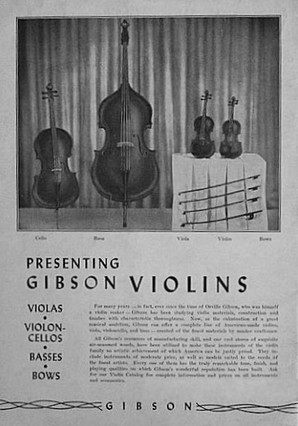
Lloyd Loar: The Man Who Took Gibson Into Jazz
In 1919, Gibson hired Lloyd Loar, a mandolin player, composer, and expert in musical acoustics.
Lloyd Loar worked at Gibson for only about five years, but his influence went far beyond that short period.
Loar was a professional musician. He played mandolin, wrote and arranged music, and had used Gibson instruments for years. But he was also fascinated by the way instruments produced sound. He wanted to know why one instrument sounded better than another.
At Gibson, he could put those ideas into practice.
One of his main goals was to make Gibson’s guitars and mandolins louder. This was especially important for professional musicians. There were no guitar amplifiers yet, so an instrument had to be loud enough on its own.
Loar made changes to the way Gibson built its carved instruments. He began using violin-style f-holes on some of the new designs. These replaced the round sound holes used on many earlier guitars.
He also changed the way the neck and fingerboard were built. The fingerboard was raised above the top of the guitar. This gave the top more room to vibrate.
Loar paid close attention to the wood itself. He would tap the top, back, and braces and listen to the sound they made. If a part did not sound right, small amounts of wood could be removed until he got the response he wanted.
This method is called tap tuning. It allowed Loar to treat each instrument as more than just another factory product.
His ideas were used in Gibson’s new Master Model instruments. The best known were the F-5 mandolin and the L-5 guitar.
The F-5 became one of the most important mandolin designs ever made. Years later, Bill Monroe played an F-5 from Loar’s years at Gibson. His mandolin playing helped define the sound of bluegrass.
The L-5 was especially important for Gibson’s future as a guitar company. It had a large carved body and violin-style f-holes. It was louder than many earlier guitars and worked much better in a band.
That mattered in jazz. Guitar players had to compete with horns, drums, and other loud instruments. A stronger archtop guitar gave them a better chance of being heard.
As these guitars became more popular, the guitar started replacing the tenor banjo in many jazz rhythm sections.
Gibson was becoming a serious name in professional guitars.
Loar also checked many of the Master Model instruments himself. He signed some of them before they left the Gibson factory. Today, these Loar-signed instruments are among the most valuable vintage Gibsons.
Loar left Gibson in 1924. After Gibson, Loar kept working with musical instruments and sound. In 1933, he helped start Vivi-Tone. The company made early electric guitars, violins, and other amplified instruments. It was not a commercial success, but Loar kept experimenting with electric instruments years before electric guitars became common.
When Lloyd Loar joined Gibson, the company was still known mainly for its mandolins. By the time he left, Gibson had become one of the leading guitar companies in America.
During this time, other talented craftsmen were also working at Gibson alongside Lloyd Loar.
Thaddeus “Ted” McHugh developed an adjustable truss rod, patented by Gibson in 1921. The metal rod inside the neck helped counter the pull of the strings and allowed the neck to be adjusted when necessary.
McHugh also worked with Lewis Williams on a height-adjustable bridge.
Adjustable truss rods and bridges later became standard parts of guitars made by companies around the world.
In 1934, a Gibson team led by Guy Hart created the Super 400 archtop guitar. Its name came from its price: $400, an extraordinary amount for a guitar at the time.
The Super 400 became one of Gibson’s top guitars and remained an important model for jazz players.
How Gibson Guitars Went Electric
By the early 1930s, guitar players in large bands had a problem. Even a loud acoustic guitar could be hard to hear next to horns and drums. Gibson had spent years building bigger and louder archtop guitars, but amplification offered another solution.
In 1935, Gibson began working on a magnetic pickup. Musician Alvino Rey helped with the project, and Gibson first worked with an engineer from Lyon & Healy in Chicago.
Later that year, the work moved back to the Gibson factory in Kalamazoo. Walter Fuller, a Gibson employee with an interest in electronics, finished the pickup design. The pickup used magnets to turn the vibration of the steel strings into an electrical signal that could be sent to an amplifier.
Gibson’s first electric instrument was not a regular guitar. In late 1935, the new pickup was first used on an Electric Hawaiian lap steel. The instrument was played flat on the player’s lap and was sold with an amplifier.
The next step was to put the same idea into a guitar.
In 1936, Gibson introduced the ES-150. The letters ES stood for “Electric Spanish”, meaning a regular guitar played in the usual position. It was basically a Gibson archtop guitar with Fuller’s magnetic pickup added to it.
The ES-150 gave guitarists something they had been missing: enough volume to play a much bigger role in a band. They no longer had to depend only on the natural volume of the guitar body.
The ES-150 became famous largely because of Charlie Christian.
Christian joined Benny Goodman’s band in 1939. At the time, guitarists in big bands mainly played rhythm. Christian used amplification to play loud, clear, single-note solos that could be heard over the entire band.
The pickup fitted to the ES-150 later became known as the Charlie Christian pickup.
Christian showed that an electric guitar did not have to stay in the background. It could play solos, compete with horns, and take the lead.
He died in 1942, at only 25 years old. His career was short, but his way of playing helped change what musicians expected from the electric guitar.
The Guitars That Made Gibson a Legend
The 1940s brought another big change for Gibson. World War II made guitar production difficult. Materials were limited, and the Gibson factory also made parts for the military during the war.
In 1944, Gibson got a new owner. Chicago Musical Instruments (CMI), a large musical instrument distributor run by Maurice Berlin.
The company stayed in Kalamazoo and continued making instruments under its own name. But Gibson had problems inside the factory. Production was not running well, and by 1948 the company was losing money.
In 1948, Ted McCarthy joined Gibson. He was a manager with an engineering background who knew how factories worked and how musical instruments were sold. McCarty had spent twelve years at Wurlitzer, one of the biggest names in the American music business.
McCarty reorganized the factory, improved production, and quickly brought the company back into profit. In 1950, he became president of Gibson.
The next sixteen years became one of the most important periods in Gibson’s story. The company grew enormously, but the biggest change was in the guitars themselves.
The legendary Les Paul, ES-335, Flying V, Explorer, and SG guitars were all created during McCarty‘s years at the company.
The Les Paul
In the early 1950s, another guitar company, Fender, was having great success with its new solid-body electric guitar, the Telecaster. Gibson decided to develop a solid-body electric guitar of its own.
The company turned to Les Paul, a famous guitarist and inventor. Les Paul had spent years experimenting with electric guitars and amplification.
Around 1940, he built an unusual solid-body guitar that became known as “The Log”. It had a solid wooden center with the sides of an Epiphone guitar attached to it, so it still looked more like a normal guitar. Les Paul had shown his idea to Gibson years earlier, but the company was not interested. At that time, a solid-body guitar still seemed too strange.
Gibson began working with Les Paul on its own solid-body model. Together, they developed the guitar that became the Gibson Les Paul.
The first Gibson Les Paul appeared in 1952. Gibson did not want to simply copy Fender’s flat-body design. The new guitar had a mahogany body with a carved maple top, a glued-in mahogany neck, and a rosewood fingerboard. It also had two P-90 pickups.
The carved top made the guitar look much more like a Gibson. Carved wooden tops had been part of the company’s instruments since the days of Orville Gibson, so the new solid-body guitar still had a clear connection to Gibson’s older designs.
The first Les Paul was finished in gold and became known as the Goldtop.
Gibson kept improving the model during the 1950s. The bridge design changed, and the Tune-O-Matic bridge gave players much better control over the guitar’s intonation.
Another big change came in 1957. Gibson began using new humbucking pickups developed by engineer Seth Lover. They were designed to reduce the electrical hum produced by single-coil pickups. They also gave the Les Paul a thicker and more powerful sound.
In 1958, Gibson introduced the Les Paul Standard with a cherry sunburst finish.
These late-1950s Les Pauls were not especially successful when they were new. Only a relatively small number were made before Gibson stopped producing the original design in 1960.
Today, those same guitars are some of the most valuable electric guitars ever made. The 1958-1960 Les Paul Standards, often called “Bursts”, can sell for hundreds of thousands of dollars.
The Les Paul became a favorite of players such as Jimmy Page, Slash, Gary Moore, and Peter Green.
The ES-335
Many players still liked the sound and feel of a hollow-body guitar, but hollow electric guitars had a problem. At high volume, they could produce unwanted feedback.
Gibson looked for a way to combine a hollow-body guitar with some of the advantages of a solid body.
The result was the ES-335, introduced in 1958.
The guitar had hollow sections on both sides of the body, but a solid maple block ran through the center. The pickups and bridge were mounted on this solid block.
This helped control feedback while still giving the guitar some of the sound and feel of a hollow instrument.
The ES-335 also had two humbuckers, a Tune-O-Matic bridge, and the double-cutaway body that made the upper frets easier to reach.
It was a new type of guitar: the semi-hollow electric.
The ES-335 became popular with blues, jazz, and rock players. Its basic construction was copied by many other guitar companies and is still used today.
Gibson later released several more expensive versions, including the ES-345 and ES-355. But the ES-335 remained the best-known model in the series.
The SG
By the end of the 1950s, sales of the Les Paul were falling. Gibson decided that its solid-body guitar needed a completely new design.
In 1961, the company introduced a much thinner guitar with a flat mahogany body and two deep cutaways.
At first, Gibson still sold it as a Les Paul.
The new guitar was much lighter than the old Les Paul. The double-cutaway body also gave players much easier access to the highest frets. It was simpler to build and had a much more modern look.
But Les Paul did not like the new design and did not want his name on it. After his agreement with Gibson ended, the Les Paul name was removed.
The guitar became the SG, short for “Solid Guitar”.
The SG soon became one of Gibson’s biggest successes. Its thin body, powerful humbuckers, and aggressive shape made it especially popular with rock players.
Angus Young of AC/DC made the SG part of his image.
Tony Iommi used SG to create the heavy sound of Black Sabbath.
By the early 1960s, Gibson had become one of the most famous electric guitar makers in the world.
The Les Paul, ES-335, and SG are still among Gibson’s most famous models. Vintage Gibsons can sell for enormous prices, and guitar makers around the world continue to build instruments based on Gibson designs.