Martin is one of the most famous acoustic guitars. Its guitars have been played in country, folk, blues, rock, and just about every kind of acoustic music.
But Martin’s history is not just about guitar design. It’s the fascinating story of a family business that began in Germany and has been running for six generations.
Quick Navigation
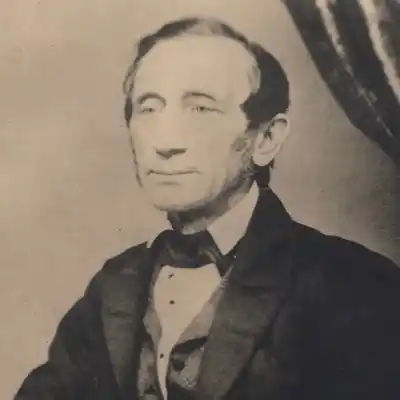
Who Started It All? C.F. Martin
Long before Martin became one of the biggest names in acoustic guitars, it was just one young German guitar maker trying to find his place in the business. His path would take him from a workshop in Vienna to a fight with local guilds, across the Atlantic to New York, and finally to Pennsylvania – where the Martin story really began.
Christian Frederick Martin started with a small workshop and a simple goal: build great guitars. Nearly two centuries later, his name is stamped on some of the most famous acoustic guitars ever made.
So how did a cabinetmaker’s son create one of the biggest names in acoustic guitar history?
A 15-Year-Old Guy Who Wanted to Build Guitars
Christian Frederick Martin was born on January 31, 1796, in Markneukirchen, Germany, a town already famous for musical-instrument making.
Martin came from a family of cabinetmakers, but guitars caught his attention early. At just 15 years old, he left home and traveled to Vienna to study with Johann Georg Stauffer, one of the best-known guitar makers of the time.
Martin turned out to be more than just a talented student. He eventually became a foreman in Stauffer‘s shop and learned construction ideas that would show up in his own early guitars years later.
After returning to Germany, Martin opened his own shop. That should have been the beginning of a quiet career as a local guitar maker.
Instead, it started a fight.
The Fight That Sent Martin to America
At the time, German trades were tightly controlled by guilds. Martin came from the cabinetmakers‘ side of the trade, while violin makers argued that only members of their guild had the right to build guitars.
Martin fought the restrictions for years. Eventually, he decided he had had enough.
In 1833, Martin left Germany with his family and headed for the United States. On November 6, 1833, they arrived in New York City. Martin opened his first American workshop and music store at 196 Hudson Street in Manhattan.
The business sold more than Martin guitars. Like many music shops of the period, it dealt in different instruments and accessories while Martin continued building guitars upstairs.
Those early American Martins still showed a strong influence from his years with Stauffer. Some had unusual scroll-shaped headstocks and other features that look very different from the Martins we recognize today.
Why Martin Left New York
New York gave Martin customers, but he never felt completely at home there.
By 1839, he had moved his family and guitar-making operation to Cherry Hill, near Nazareth, Pennsylvania. From then on, Pennsylvania became the real home of Martin guitar production.
Martin still depended heavily on New York for sales. One important dealer was guitarist and teacher John Coupa, who sold Martin guitars from his studio at 385 Broadway. Some surviving instruments from this period even carry Martin & Coupa labels.
That explains something that can confuse owners of very old Martins today: guitars made in Pennsylvania could still be marked “C.F. Martin, New York.”
The New York name referred to the company’s sales connections, not necessarily where the guitar had been built.
The Bracing Idea That Changed the Acoustic Guitar
Martin’s early guitars were influenced by both Viennese and Spanish builders, but he kept experimenting.
One of the most important changes happened inside the guitar, where nobody could see it.
By the 1840s, Martin was working with a new way of supporting the soundboard. Instead of arranging the wooden braces in simpler patterns, two main braces crossed beneath the top in the shape of an X.
It became known as X-bracing.
Martin did not develop it because he knew steel-string guitars would dominate decades later. At the time, guitar strings were still made from gut. But X-bracing created a strong and responsive guitar top, and that design later proved especially useful when steel strings began putting much more tension on acoustic guitars.
X-bracing became one of Martin’s most important contributions to guitar design, and versions of it are still used in acoustic guitars around the world today.
C. F. Martin Company: One Family, Six Generations
Christian Frederick Martin died in 1873, but the company stayed in the family. The company stayed in the family, passing from one generation to the next. Each new leader had to deal with changing musical tastes, growing demand, and a very different guitar market.
When the Business Really Started to Grow: Frank Henry Martin
His son, C.F. Martin Jr., took over and helped the small workshop increase production without losing the quality that had built its reputation.
When Martin Jr. died in 1888, leadership passed to his son Frank Henry Martin.
Frank Henry arrived at exactly the right time to see American music change dramatically. Mandolins became fashionable. Then came the ukulele craze. Soon after that, musicians wanted louder steel-string guitars.
Each trend pushed Martin in a new direction.
The Tiny Instrument That Helped Martin Grow
It may seem strange today, but for a period in the early 20th century, the ukulele was a huge part of Martin’s business.
Martin had experimented with ukuleles earlier, but production really took off after the Hawaiian music craze hit the mainland United States.
The company began building mahogany ukuleles in larger numbers around 1915, and its first dedicated ukulele catalog appeared in 1917. Demand became enormous.
Between 1916 and 1926, Martin built fewer than 17,000 guitars but nearly 57,000 ukuleles. In 1925 alone, more than 14,000 ukulele orders came in, enough to force the factory to expand.
For a company famous today for large acoustic guitars, one of its biggest early growth periods was powered by a very small four-string instrument.
The Guitars That Made Martin Famous
At the beginning of the 20th century, Martin introduced some of the guitars it would later become famous for, including the Dreadnought and the D-45.
Dreadnought: The Giant Guitar Named After a Battleship
While ukuleles were booming, another Martin design was taking shape at the opposite end of the size spectrum. Musicians wanted more volume.
In 1916, Martin built an unusually large custom guitar for Hawaiian musician Mekia Kealakai. That oversized instrument helped lead to a new wide-bodied design developed through Martin’s work with the Ditson Company. The guitar was huge compared with most instruments of the day.
Frank Henry Martin thought its size was reminiscent of the giant HMS Dreadnought battleships, and the name stuck.
The Dreadnought was born. At first, the Dreadnought was hardly a runaway success. Very few were built for Ditson.
Then Ditson went out of business in 1931, and Martin decided to sell the big guitars under its own name. The D-18 and D-28 followed. That decision changed acoustic guitar history.
The Dreadnought’s strong bass, high volume, and big sound made it perfect for country, bluegrass, folk, and eventually rock. Today, the shape has been copied by guitar companies around the world and has become what many people picture when they hear the words acoustic guitar.
Why 14 Frets Changed the Guitar Again
Older Martin guitars normally joined the body at the 12th fret.
That limited access to the higher part of the neck.
In 1929, Martin built a six-string guitar for Perry Bechtel with 14 frets clear of the body. The idea developed into the Orchestra Model, better known today as the OM.
The change may sound small, but it helped create the basic layout used on most modern steel-string acoustic guitars.
By 1934, Martin also gave its Dreadnoughts 14-fret necks, helping establish the familiar D-18 and D-28 shape that players still recognize today.
The D-45: Martin Builds Its Ultimate Guitar
If the D-28 became one of Martin’s most famous working guitars, the D-45 became its showpiece.
The first D-45 was built in 1933 for singing cowboy star Gene Autry. Autry wanted something special, and Martin delivered: a large Dreadnought covered with the company’s highest-level pearl decoration. It was built to impress.
Martin made only 91 original pre-war D-45s between 1933 and 1942, when production stopped during World War II. Those guitars are now among the most valuable and collectible acoustic guitars ever made.
Demand never completely disappeared, and Martin finally brought the D-45 back in 1968.
Today, the D-45 still sits near the top of the Martin line, while the surviving pre-war originals have reached almost mythical status among collectors.
When Martin Became Part of American Music
By the middle of the 20th century, Martin guitars had become part of the sound of American music. Folk singers, country players, and eventually rock musicians put Martin guitars in front of huge new audiences.
The Folk Boom Makes Martin Bigger Than Ever
By the 1950s and early 1960s, acoustic guitars were everywhere again.
The American folk revival turned artists with Martin guitars into stars, and suddenly the old factory could barely keep up.
Groups such as The Kingston Trio, Peter, Paul and Mary, and other folk acts helped drive demand so high that Martin opened a much larger factory in 1964 at 510 Sycamore Street in the Nazareth.
Then folk-rock arrived. Acoustic guitar was no longer just an old-fashioned instrument. It had become part of the sound of a new generation.
Martin Tries Going Electric
Martin built its reputation on acoustic guitars, but that did not stop the company from experimenting with electricity.
As amplified music became more important in the late 1950s and 1960s, Martin tried adding pickups to traditional flat-top guitars and later produced true electric models.
The F Series, introduced in 1961, included thin-body electric guitars such as the F-50, F-55, and F-65. Later came models such as the GT-70 and GT-75.
None of them came close to replacing Fender or Gibson in the electric-guitar world.
Martin’s identity remained acoustic.
Ironically, one of its most famous amplified guitars would become famous decades later: Kurt Cobain‘s 1959 Martin D-18E, used during Nirvana‘s legendary MTV Unplugged performance.
Sometimes even Martin’s less successful experiments find their place in guitar history.
Martin Guitars Today
Christian Frederick Martin IV, better known as Chris Martin, grew up around the family business.
As a boy, he helped package guitar strings. Later, he worked in different parts of the company and gained experience outside Martin before returning full time.
In 1986, after the death of his grandfather C.F. Martin III, Chris became the sixth generation of the family to lead the company.
He would serve as CEO for 35 years.
During his time in charge, Martin expanded into new price ranges, materials, manufacturing methods, and guitar designs while continuing to build traditional models such as the D-18, D-28, and D-45. Products such as the X Series helped make the Martin name available to players who could not afford one of the company’s traditional American-made Standard Series guitars.
In 2021, Chris Martin stepped down as CEO and moved into the role of Executive Chairman. Thomas Ripsam became Martin’s first CEO from outside the Martin family.
Chris remains the owner and Chairman of the Board, keeping the family closely involved in the company nearly two centuries after his great-great-great-grandfather arrived in New York.
C.F. Martin & Co. is still family-owned, and the company still builds guitars in Nazareth, Pennsylvania, while several more affordable lines are produced at its facility in Mexico.
The company has now passed the three-million-guitar mark, but some of its most important ideas are surprisingly old.
X-bracing dates back to the 19th century.
The Dreadnought story began more than a century ago.
The 14-fret steel-string layout took shape around 1929.
And the D-18, D-28, and D-45 are still instantly recognizable descendants of guitars Martin was building before World War II.
That may be the most unusual part of the Martin story. The company became famous by constantly changing the guitar – and then became legendary by knowing which changes were worth keeping.
How to Tell How Old a Martin Guitar Is
Dating a modern Martin is usually easy because the company has used serial numbers for well over a century.
Martin began its continuous guitar serial-number system in 1898. The first numbers started around 8000, an estimate of how many instruments the company had already built by that point.
Guitars made before 1898 usually have to be dated using stamps, construction details, measurements, and other clues instead.
The stamps themselves also tell part of the story.
Early guitars used versions of “C.F. Martin, New York.” In 1867, the company began using “C.F. Martin & Co., New York.” After its New York sales arrangement ended in 1898, the familiar Nazareth, Pennsylvania name began appearing instead.
That makes the inside of an old Martin almost like a small historical record.